Difficult to ID
Along with gulls, flycatchers are another family that is very difficult to ID. Previously, we have recommended a book on gull identification. Now for the flycatchers.
The Family Tyrannidae
The Flycatchers are known as the family Tyrannidae, or in English, the Tyrant Flycatchers. You may know that the word “tyrant” means someone who is a cruel dictator. This name is applied to flycatchers because some of them, especially the Kingbirds, are very aggressive and will attack any other bird that comes near their nest, even birds that are much larger.
Animal families are divided into genera or sub-families of similar species. North American flycatchers are divided into nine genera as follows: (genera is the plural of genus).
- Puchyramphus – Becards (only near the Mexican border in California & Texas)
- Camptostoma – Beardless Tyrannulets (only near the Mexican border in California & Texas)
- Pyrocephalus – The Vermillion Flycatcher is unique because it is the only red flycatcher.
- Contopus – Olive-sided flycatcher and the Pewees (5 species)
- Sayornis – The Phoebes ( 3 species, easy to ID from other flycatchers).
- Myiodynastes- The Sulpher-bellied Flycatcher. (easy to ID with yellow breast with black streaks, Only in southern Arizona and Texas)
- Myiarchus – Flycatchers with pale yellow breasts (4 species)
- Empidonax – Small, brown flycatchers (11 species).
- Tyrannus – The Kingbirds (9 species)
There are more than 400 species of flycatchers, but the majority of them are in Central and South America.. These books cover the species that are found north of Mexico as well as a few Mexican and Caribbean species that are occasionally seen in the southern USA.
The Books
Princeton University Press has published two excellent books on flycatcher ID. One book is for the Empidonax and Pewees, and the other is for Myiarchus and Kingbirds. Although this covers only four of the nine genera, these four include most of the flycatchers and all the ones that are difficult to identify. Four of the other five genera contain only a single species and have distinct colours or patterns, making them easy to ID.
North America Flycatchers
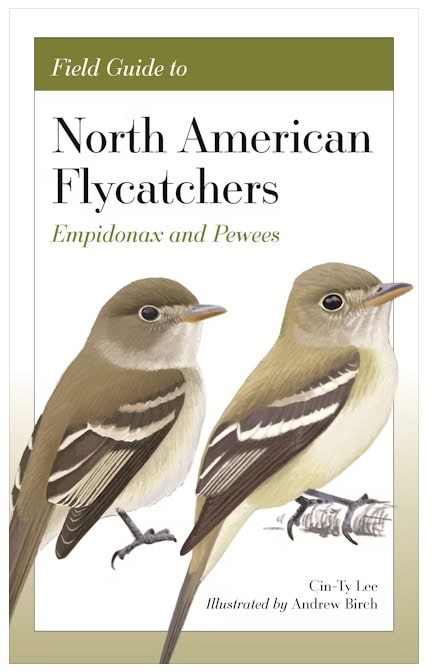
Princeton Field Guide to North American Flycatchers by Cin-Ty Lee 2023
The first of two books. The one covers Empdonax and Contopus (Pewees)
Flycatchers are very difficult to identify. For this reason, this is a desperately needed publication. Many look alike until you know how to spot the minor details that tell them apart.
The family Tyrannidae (flycatchers) is divided into nine genera (sub-families). This book covers the Empidonax and Contopus (Pewees) genera. The Empidonax has 11 species, and the Contopus has five.
In addition to the number of species listed above, the book also includes the following:
- the Cuban Pewee, which is found in Cuba and the Bahamas,
- the Tufted Flycatcher, which is found from Mexico to Ecuador,
- the Pine Flycatcher, which is found in Mexico and a little bit into Guatemala.
- the Buff-breasted Flycatcher, which is found from Mexico to Costa Rico
These species are included because they sometimes appear in the southern USA as a vagrant.
The book describes many different methods of identifying a flycatcher as follows:
- The shape of the head. Some have peaked crowns, some are round, and some are flat.
- The angle of the forehead from the top of the head to the bill.
- The length of the bill.
- The lower mandible colour
- The tail length.
- The tail width
- The length of the primary feathers
- The wingbars.
- Contrast between secondaries and primary wing feathers.
- Underpart contrast.
- The eye-ring
- Overall colour
- Wing flicking
- Tail flicking
- Vocalizations
- Habitat
- Range
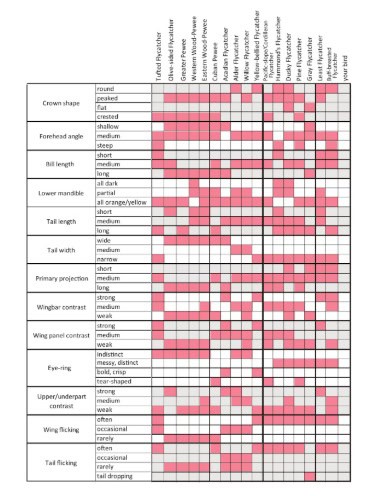
Then, it puts all the above characteristics into a chart that tells which species has which characteristics. This can really narrow down your choices for identification.
The Species
After all the above information, the book gives detailed data for each species. This includes:
- General Identification
- Voice
- Drawings
- Range
- Habitat
- Similar species
- A range map
For vagrant species, it also lists the months the bird might be seen in the southern USA.
The Range Maps
There are two range maps for each species, showing the location of the birds. These maps give the following details:
- The summer and winter ranges
- Lines showing where the species will be at certain months of their migration.
- Several bar charts show where the birds may be seen around North America.
The Illustrations
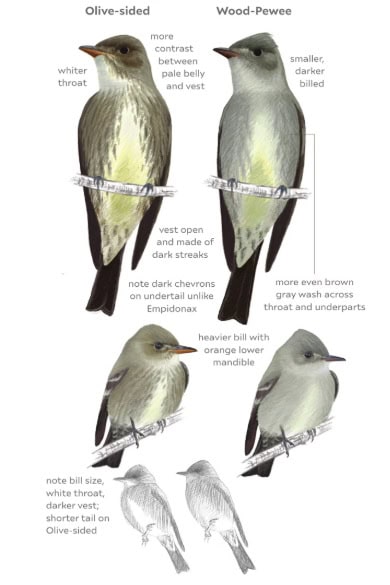
The book has between three and ten detailed drawings of each species, with an average of seven or eight, depending on how many ID features need to be shown. Andrew Birch made these excellent drawings.
For Birdtripper Members O
Birdtripper members get 30% off Princeton books. Click members to register.
(M) Write a review
You must be logged in to submit a review.
North American Flycatchers
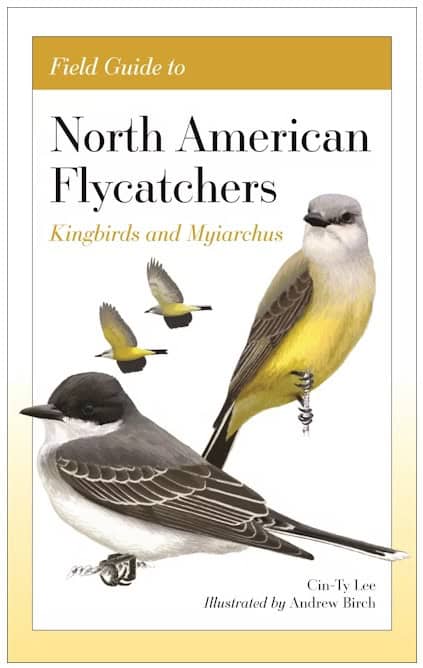
Princeton Field Guide to North American Flycatchers by Cin-Ty Lee 2023
The second of two books. The one covers Myiarchus and Tyrannus (Kingbirds)
The Myiarchus and Tyrannus genera of flycatchers are larger than the species described in the first book. Hence, this is your first clue to identification. So another way to name these two books are:
- Empidonax and Contopus – Small Flycatchers
- Myiarchus and Tyrannus – Large Flycatchers
So, you have already eliminated half the possibilities by knowing which of these two books to look at.
This book is very similar to the one described above, except for the species, so I will not repeat all the features.
In conclusion, this book, coupled with the previous one, will enable you to identify most flycatchers.
You must be logged in to submit a review.