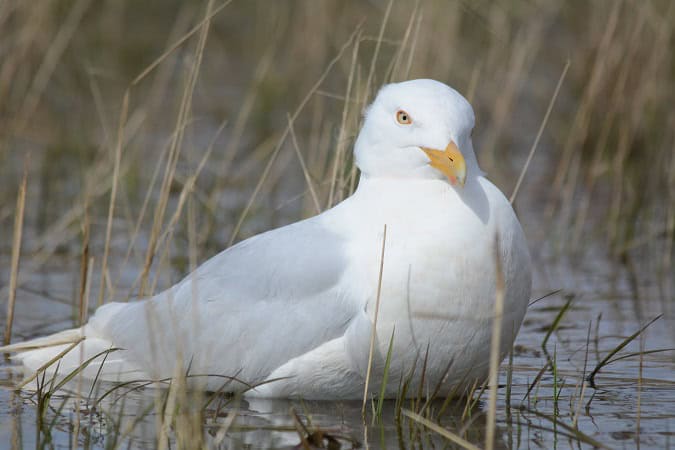
A large, predatory Arctic Gull.
One of the largest Gulls
The Glaucous Gull is one of the largest of the more than 50 different species of gulls around the world. They breed on the Arctic coast. They are circumpolar and are found along the Arctic shore in North America, Greenland, Scandinavia and Russia. During winter, they move further south and can be seen along the east and west coasts of Canada, southern Alaska, southern Greenland, Iceland, southern Scandinavia, Great Britain, Ireland, northern France and the Pacific coasts of Russia and China. They make their nest on the ground or on a cliff.
The Glaucous Gull is the second largest gull after the Great Black-backed Gull. It can range in size from 55 to 77 cm in length (22 to 30 inches), with a wing span of 132 to 170 (52 to 67 inches). They can weigh anywhere from one to 2.7 kilos (about two to six pounds).
Identification
The Glaucous Gull can be identified by the lack of black on it. Most gulls have black wing tips. In North America, eliminating all gulls with black on them leaves only a couple that might be confused with the Glaucous Gull. The Iceland Gull and the Glaucous-winged gull have grey and white wing tips. The Ivory Gull is pure white. The Glaucous Gull is the only one with a grey back and white wing tips. Their range can also eliminate the Glaucous-winged Gull and the Iceland Gull. Except in extreme northeastern Canada and Greenland, their ranges do not overlap. Glaucous means “light gray” in Latin. Like most gulls, immature birds are brownish or grey and look quite different from adults. Most gull species take three or four years to achieve adult colours.
What they eat
The Glaucous Gull will eat almost anything, including fish (both dead and alive), carrion, insects, berries and seeds. They are very aggressive and predatory, attacking ducks and other birds and eating their eggs and chicks. Glaucous Gulls will also prey on rodents and other small mammals. They are not your average gull that lives primarily on dead fish and garbage.
If you visit the Arctic coast, see if you can spot this large, predatory gull.