Mexico, Belize, Costa Rica, and Panama are the most popular countries in Central America for birding. All of them except Mexico have excellent bird guidebooks. However, the only good Mexican guidebook I know is “Peterson Field Guides Mexican Birds. This was published in 1973 and updated in 1999 and includes Belize, El Salvador, Guatemala, and Honduras. There does not seem to be a good book on Birds of Mexico without other countries included. This adds extra species which may or may not exist in Mexico.
There is a separate guidebook for Northern Central America, excluding Mexico, which is better if you go to Belize, El Salvador, Guatemala, and Honduras, but not Mexico. Details are below.
How to choose the best guidebook. Read this before writing a review.
Mexico and Central America
Birds of Mexico and Central America

Princeton Guide by Ber Van Perol. 2006.
This is a handy book for all of Central America. There are better books for individual countries, but I like this book and think it is good to have both. It is small enough to carry in the field, and you can compare it to the larger books when you return to your hotel. Unfortunately, it is now out-of-date as there have been many taxonomic changes since it was printed.
It features the standard layout with birds on the right and text on the left. However, this is not much in the way of text. Descriptions and other information are very brief. The taxonomic order is AOU 1998.
It has small drawings of several birds per page. However, the drawings are good, and there are two to four of each species. It does not point out information on similar species.
One feature of the book that I do not like is that the maps are located at the back of the book instead of with the drawings. You need to note the bird’s number and then look up the corresponding map at the back.
Each bird has its name in Spanish, English, and scientific name. I found this to be really helpful when asking for help from someone who does not know the bird’s English name. The book is worth having for the Spanish translations alone.
There are three indexes for English, scientific, and Spanish names, which is good. However, there is no index by family name. There is also no large bold letter to divide the letters of the alphabet, which would speed up searching. Therefore, I printed the letters myself.
Another problem with this book is that it covers all of Central America, which means there are too many birds to sort through if you are only looking for birds of Mexico.
The print quality of the book is good.
Birdtripper members get 30% off Princeton books. Click members to register.
What do you think? (M) Write a review
You must be logged in to submit a review.
Mexico and Northern Central America
Birds of Mexico and Northern Central America
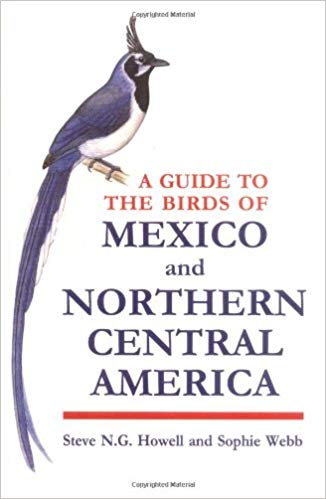
Oxford Press by Steve Howel and Sophie Wegg. 1996.
This is a large book; hence, it is a bit heavy to be called a field guide. It is a comprehensive book covering Mexico and the Central American countries of Belize, Guatemala, El Salvador, Honduras and western Nicaragua. It has 71 colour plates and includes information on 1,070 species, including 180 endemics with pictures of 750 species. In addition, there are lists of birds divided into categories of residents, migrants, endemics, and transients who are just passing through to destinations further south. Information on birds of nearby Pacific and Caribbean islands is also given. Furthermore, it includes much valuable general information about birding in the area.
This is a great book. The drawbacks are the size and weight of the hardcover book and the fact that the maps are not on the same page as the pictures.
A quote from Mark Stackhouse, a prominent bird guide in Mexico: “Although this book is old and needs to be updated, it is still the best guidebook available for birds of Mexico. (You can hire Mark for birding in Mexico. See the guides page).
(M) Write a review
You must be logged in to submit a review.
Birds of Mexico and Adjacent Areas
by Ernest Edwards. University of Texas Press 1998.
The first printing was in 1998. This is the seventh printing, third edition. It was printed in 2015, but that is just a printing date and not the date of the third edition, so the actual date of the latest revision is unknown.
The book covers the countries of Mexico, Belize, Guatemala and El Salvador, but not Honduras as in the previous books.
The size is good for a field guide, but the layout is unorthodox. It is sometimes difficult to find where the information on one bird family ends and the next starts, and the data for the next bird family does not start on a new page. An easy fix is to highlight the family names with a yellow marker to make them stand out. The only redeeming feature is that it has the names of the birds in Spanish and English, which is useful when talking with local people.
The drawings are on colour plates in the book’s centre, not with the corresponding text. The drawings are excellent, but there are about 20 birds per page, which is a bit overwhelming. Most birds are illustrated, but not all.
The taxonomic order is unknown. It does not follow any current checklist. There is no information on similar species, and there are no maps.
There is just one index with English, Spanish, and scientific names but no bold headings to separate family names. Spanish and scientific names are listed alphabetically and not with English names; they are only for families and not individual species. For example, the word for “Woodpecker” is listed in English under “W.” The scientific name “Picoides” is listed under “P,” and the Spanish name “Carpintero” is listed under”C.”
Spanish or scientific names for individual species are not provided, only family names. Spanish and scientific names for individual species are included in the text but not in the index.
It’s not a very good book. As described below, there are better books for Guatemala, Belize, and El Salvador.
(M) Write a review
You must be logged in to submit a review.
All of the above books are obsolete. We list them here because there does not seem to be any current field guides for Mexico. There are good current books for the other countries in Central America.
Central America
Birds of Central America
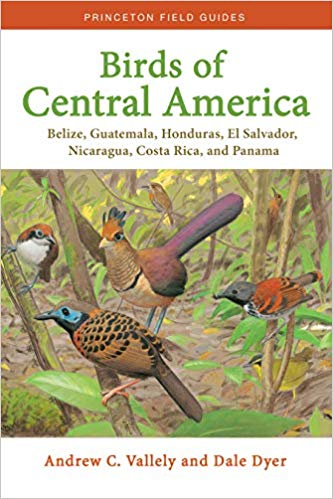
Princeton Field Guide by Andrew Vallely & Dale Dyer. 2018
Does not include Mexico. Almost 1,200 species, both residents and migrants. There are 260 plates with very good illustrations showing different ages and sexes for each species, with four to six species per page. Text and range maps are located on corresponding pages.
A good book, but unless you are touring all of Central America, you are better off going with a field guide that is country-specific.
(M) Write a review
You must be logged in to submit a review.
Birds of Northern Central America
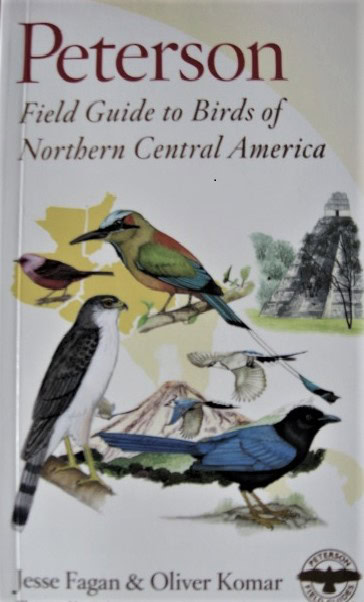
Peterson Field Guild to Birds of Northern Central America. Published by Houghton Mifflin Harcourt 2016. Written by Jesse Fagan & Oliver Komar and illustrated by Robert Dean & Peter Burke.
A good-sized field guide, up-to-date with the standard layout of birds on the right and text and maps on the left.
In this book, “Northern Central America” refers to the countries of Belize, Guatemala, El Salvador, and Honduras.
Robert Dean and Peter Burke drew excellent images. Robert Dean also drew the images for the Nicaragua, Costa Rica, and Panama books described below.
Very detailed maps show permanent residents, visitors, breeding visitors, transients, and vagrants, with different colours for winter and year-round residents. They also show red dots for breeding colonies, something we have not seen in any other field guide.
The text describes the birds well, with four or five species per page, which is not too crowded. Bird family names are in large bold letters at the top of each page for easy scanning. The book also gives an abundance estimate to determine if the bird is common or rare. One drawback is that it does not provide the names of the birds in Spanish. The book covers 827 species and an appendix listing rare and vagrant visitors. The taxonomic order is ebird Clements 6.9.
There is a single index for English and scientific names with no bold or family division. However, a separate bird family index is inside the front cover and continues inside the back cover, which works better than finding individual species in the index.
Additional Features
In addition to the standard guidebook features, there are a few extras. One is a two-page list of species endemic to the area.
Information is included on birding the Pacific Slope compared to the Caribbean side and the north compared to the south. Several pages describe 17 habitats, including mangroves, pelagic birding, rain forests, cloud forests, and much more.
It would be nice if all field guides were as good as this one. It is a must-have if you intend to bird in this area, especially for Guatemala and El Salvador, for which there are no other decent guidebooks. The pages are printed on very high-quality paper, which is nice. Peterson books set the standard for what a field guide should look like—highly recommended. Write a review.
The only fault I can find with this excellent publication is the lack of a bold letter of the alphabet to divide the index and make it easier to find individual species.
(M) Write a review
You must be logged in to submit a review.
Belize
Birds of Belize

Birds of Belize. University of Texas Press by H. Lee Jones 2003
This book is a bit too big to lug around in the field. However, it is a superb guide for birds of Belize, featuring nearly 600 species. It is divided into three sections. The first part is a typical bird field guide layout with brief descriptions and very good drawings. The second section gives extra detailed information on each species. Finally, the last section shows the range maps.
Images and maps are very good but would be a lot better if they were located together. A major fault with this book is that there is no link between the species and the maps. For each bird, there is a page number for more information. Turning to that page will get you the map number. After that, you turn to the map section. It is a complicated and time-consuming practice. To rectify this, I wrote the number for each species in the first section for its corresponding range map. There are maps for 234 out of almost 600 species in the book.
A great deal of information is given on each species, including other names for the species. However, no information points out the slight differences between similar species. The taxonomic order used is AOU as of 2003. There is a single index with English and scientific names but no bold titles or divisions for family names.
This is an excellent reference book that any serious Belize birder should have in their library. However, it is too big to be a field guide, and the lack of maps is a big problem. The book is on good-quality paper.
(M) Write a review
You must be logged in to submit a review.
Honduras
Birds of Honduras
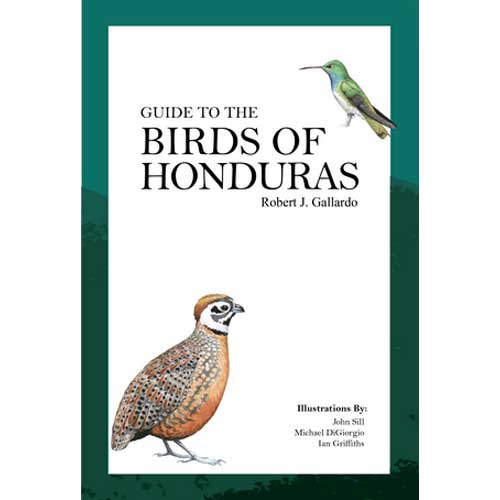
Birds of Honduras by Robert Gallardo 2015
It also has a bird-finding section and covers most of the species of Guatemala, El Salvador, Belize, Nicaragua, and Honduras. We have not read this book. Write a review.
(M) Write a review
You must be logged in to submit a review.
Nicaragua
Birds of Nicaragua
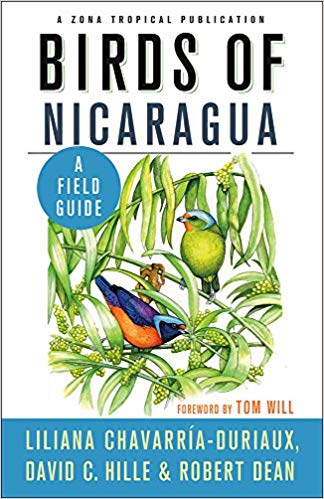
Birds of Nicaragua. Zona Tropical Publication by Liliana Charvarria-Duriaux & David Hille & Robert Dean 2018
Descriptions and drawings of all 763 species to be found in Nicaragua, including excellent illustrations by Robert Dean, good range maps and a checklist of all birds.
We have not read this book, but if it is as good as the other books by Zona Tropical with drawings by Robert Dean, this will be an excellent book. Write a review,
(M) Write a review
You must be logged in to submit a review.
Costa Rica
Birds of Costa Rica
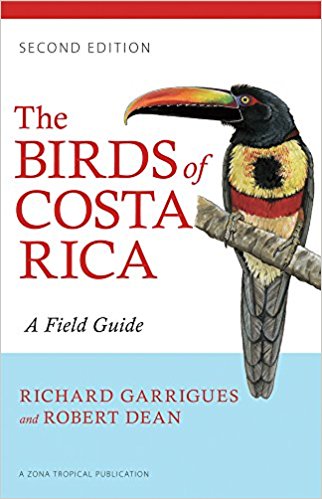
Birds of Costa Rica. Zona Tropical Publication by Richard Garrigues 2nd edition 2014
This is a good-sized field book. It has the standard layout, with birds on the right and text and a map on the left. There are four or five species per page, so it is not crowded. There are 903 Species. However, 53 of these species are rare visitors, leaving 850 Costa Rican birds.
The illustrations are excellent, drawn by the very talented artist Robert Dean.
As Costa Rica is a tropical country, the maps do not show summer and winter ranges as they do in the north. However, the excellent maps show breeding residents, non-breeding residents, transients migrating through Panama, breeding migrants that come to Panama only to breed and then leave, and rare vagrants. Some books put the maps in a separate section, which is not very good.
The text is very good. Not too brief. It describes all 903 species known to reside in Costa Rica or migrate through. The unique features of each species are in bold, which is a nice touch to make them stand out for quick identification. It also mentions the abundance status to tell you if the bird is easy to find. The only thing missing from the text is the species’ name in Spanish. The name in Spanish would be good when talking with the local people about the birds.
The book follows the Clements checklist version 6.8
The index includes both English and Scientific names but not Spanish. Family names are in bold, making scanning the index for a specific bird family easy. Inside the back cover is a separate index that gives the page number for the first bird in each family, which is great if you know the bird family but don’t know the name of the individual species you are looking for.
Additional Features
This book has some excellent features that are not standard in the average field guide.
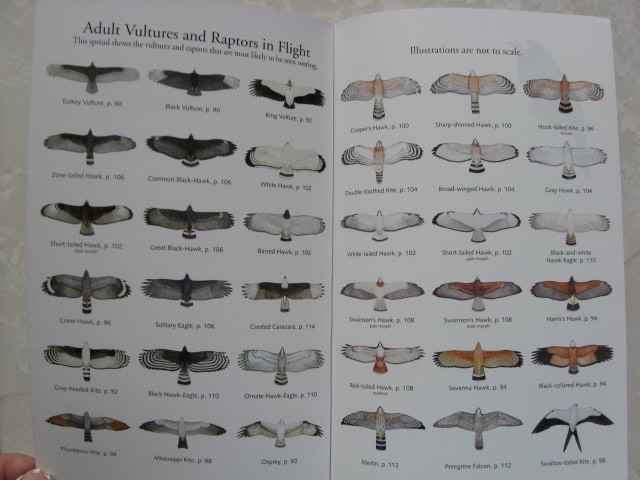
Inside the front cover is a two-page spread showing raptors in flight. This is an excellent aid to identifying raptors that you see only from below.
Bars across the top of each page contain the family names. A quick thumbs-through of the book will direct you to the bird family you want without using the index.
There is a map of Panama showing the mountainous areas and elevation.
Near the back of the book is a checklist of the birds of Panama, where you can record your sightings. It has a column for the English name, the scientific name, and a space for the location and date. This small box might be suitable for writing the date, but not much more. It is too small to write both the date and the location’s name. However, it is a feature that most books do not have.
The print quality is very good; overall, this is a great field guide for your trip to Costa Rica. It is recommended. What do you think? If you use this book, write a review.
(M) Write a review
You must be logged in to submit a review.
Birds of Costa Rica
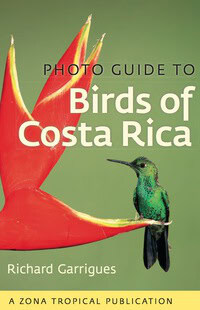
Photo Guide to Birds of Costa Rica by Richard Carrigues. A Zona Tropical publication 2015.
The Photo Guide to Birds of Costa Rica is a companion book to the Field Guide for Birds of Costa Rica described above by the same author and publisher. It features 549 excellent photographs instead of drawings. There are photos of more than 40 per cent (365) of the species known from Costa Rica, which is about 75 per cent of the birds commonly seen.
It is not a field guide. It is for birders who wish to have a photographic reference in addition to the drawings in the field guide—published in 2015.
(M) Write a review
You must be logged in to submit a review.
The book on Costa Rica above and the one on Panama below are very similar. They have different authors who know the birds of their country best. However, they are both published by Zona Tropica, and both have the same artist for the illustrations. Most of the features of the books are the same, so if you own one of these guides, you will have an excellent idea of what the other one is like. Therefore, the reviews for these two books are much alike. They follow different taxonomic order, and the Coast Rica book has a family index in addition to the regular index, which the Panama book does not. Both are excellent field guides for their respective country.
Panama
Birds of Panama
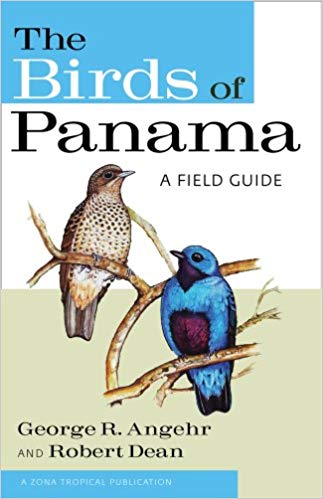
Birds of Panama. Zona Tropical Publication by George Angehr 2010
A good size field book. It has the standard layout with birds on the right and text and maps on the left. There are four or five species per page, so it is not crowded.
The book has more than 900 excellent images, including all species known to breed in Panama, drawn by Robert Dean, the same artist who drew the birds in the Birds of Costa Rica book above. If females and juveniles differ from males, there is more than one image per species.
As Panama is a tropical country, the maps do not show summer and winter ranges as they do in the north. However, the excellent maps show breeding residents, non-breeding residents, transients migrating through Panama, breeding migrants that come to Panama only to breed and then leave, and rare vagrants. Some books put the maps in a separate section, which is not very good.
The text is very good. Not too brief. It shows the unique features of the bird in bold, which is a nice touch to make them stand out for quick identification. The text also mentions the abundance status to tell you if the bird is easy to find. The only thing missing from the text is the species’ name in Spanish. The name in Spanish would be good when talking with the local people about the birds.
The book follows the AOU taxonomic order and includes some species not recognised by the AOU—there is no information on similar species except for a few that can be separated only by their call.
The single index has English and Scientific names together, but it is very easy to use as there are only two columns. Most books use three columns for the index. There is no bold or family index to look up bird families instead of individual species.
Additional Features
This book has some excellent features that are not standard in the average field guide. Inside the front cover is a map of Panama showing the mountainous areas.
Near the front of the book is a two-page spread showing raptors in flight—an excellent aid to identifying raptors that you see only from below.
Bars across the top of each page contain the family names. A quick thumbs-through of the book will direct you to the bird family you want without using the index.
At the back of the book is a checklist of the birds of Panama, where you can record your sightings. It has a column for the English name, the scientific name, and a space for the location and date. This small box might be suitable for writing the date, but not much more. It is too small to write the date as well as the name of the location. Still, it is a feature that most books do not have.
The print quality is very good, and overall, this is a great field guide for your trip to Panama. It is recommended. What do you think? If you use this book, write a review.
(M) Write a review
You must be logged in to submit a review.