Guidebooks to the Birds of North America
North America is a vast place with a lot of birds. However, many birds living on the west coast differ from those in the east. For this reason, and to keep the book to a reasonable size, most North American guidebooks are limited to the western or eastern half of North America.
How to choose the best guidebook. Read this before writing a review.
Pet peeves. Two things that annoy me in guidebooks are a poor index with English and Scientific names in small print with no bold family names and no alphabetical separation, making it difficult to use. The other peeve is guidebooks that only give Imperial measurements. This is ok for Americans but not for the rest of the world. Many American publishers don’t seem to know that many people from Canada and other countries visit the USA for birding
Some books cover all of North America. Most are too big to carry in the field but are excellent home reference books. We will cover these books first.
Stokes Birds of North America
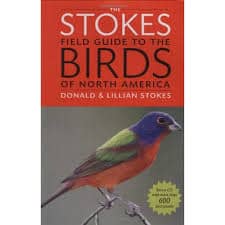
Stokes Birds of North America 2010
It’s an excellent book but too big to carry in the field. A home reference book. This book has one or two species per page in a vertical format with several photographs of each species, including males, females, adults and immature birds. For some, such as the Laughing Gull, there are two full pages and eleven photographs.
Range maps are shown at the bottom of the page. One fault is that it gives the length of the birds only in inches with no mention of the wingspan. There is plenty of information about each species, including flight patterns and sub-species—no mention of similar species for each bird.
It uses the ABA taxonomy and covers 854 species, including rarities. There is a single index for both English and scientific names with no highlighting for family names or letters of the alphabet. However, there is a quick reference index by families inside the front cover, which is a lot easier to use in most cases than looking up individual birds in the index, except for those very large families. There is also a coloured bar across the bottom of each page indicating the family name. The book also comes with a CD of more than 600 bird sounds. It is well printed on glossy pages, but my copy’s binding is falling apart even though the book was not used in the field.
(M) Write a review
You must be logged in to submit a review.
Sibley Guide to Birds
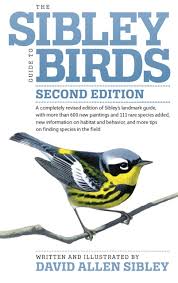
Sibley Birds 2nd Edition 2014
Another excellent guidebook. Describes 923 species, including Hawaii, Bermuda and Greenland. The birds are drawings vs photos in the Stokes book above. However, the drawings are very accurate and depict birds in flight and perched. There are about seven or eight drawings of each bird in different stages of life and plumage. Like Stokes’ book, it is very big and heavy. A home reference book.
This might be the best North American guidebook, but it is also the most expensive, at about $45 U.S.
The book is also available as an app, which includes the book plus 2,800 audio recordings. It costs about $20.
(M) Write a review
You must be logged in to submit a review.
Peterson Guide to Birds of North America
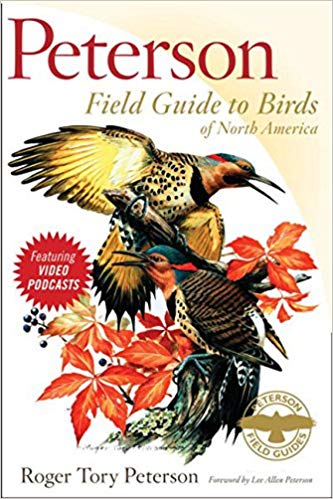
Peterson Field Guide to Birds of North America 2008
Another popular guidebook like Sibleys and Stokes. All of these books are excellent. They are similar but with some differences, and much of the choice is a matter of personal preference. This book is laid out in typical bird guidebook format with the birds on the right and text and maps on the left.
(M) Write a review
You must be logged in to submit a review.
Guide to Birds of North America
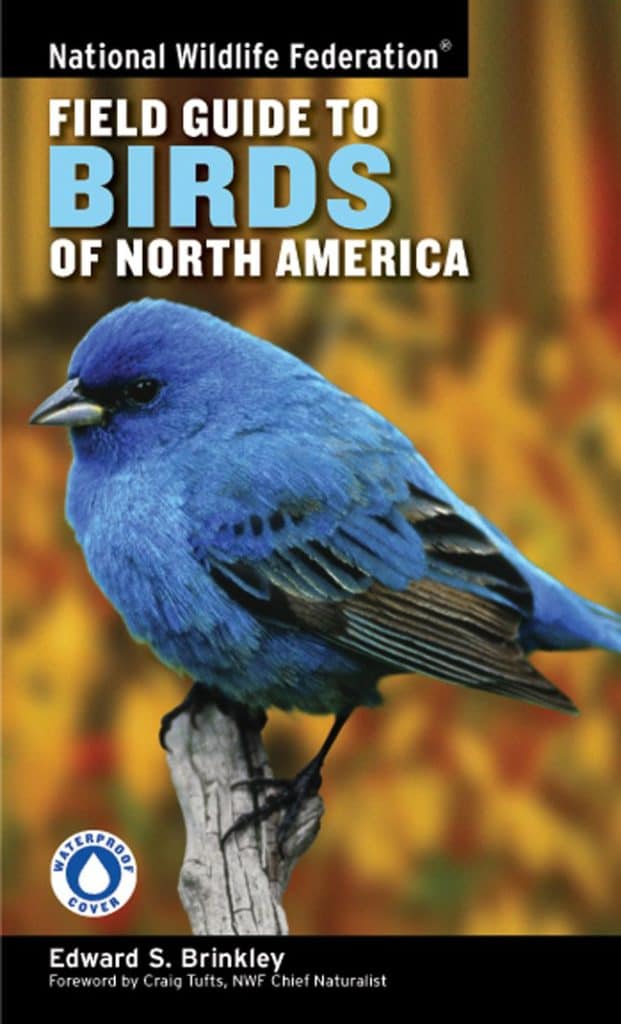
National Wildlife Federation Birds by Edward Brinkley 2007
It is labelled as a Field Guide but is a bit thick and heavy to take in the field. Also, it describes all the birds of North America, whereas I think the books for only east or west are better for the field. However, it is an excellent reference book, and we highly recommend adding it to your library.
The layout is different from most bird books. Each page is divided into halves, with two species per page instead of the usual birds on the right and text on the left. This is a really good idea because it keeps the photos, text, and maps all together in a half-page square.
The book has 2,100 photographs of 750 species, with at least two photos of each species and sometimes three. The images are excellent. It uses the AOU taxonomy and nomenclature. The text is short, with more information about habitat and migrations than description. There is no information about similar species, but it describes each bird’s calls.
It has one index with bolded bird names to separate them from scientific ones, which is nice. There is also an index with family names inside the back cover, which is very handy. A coloured bar across the top of each page shows the family name. There is a page or two of very good introductory information for each bird family that most other books limit to a paragraph or so.
Additional Features
This guide has some excellent additional features not found in most books. The table of contents has family names and two or three photos to represent the family so that you can look up the bird family by photographs or words. The only problem with this is that it starts on page six and is not too handy unless you stick it in a bookmarker so you can find it quickly.
In addition to the usual information about birds in general that all guides have, this book has a glossary of birding terminology at the back. Here, you can look up the meaning of everything from dimorphic to Boreal Forest.
There is a list of rare, vagrant and extinct birds that are not described in the book. There is a list of threatened birds, but they list only two categories: endangered and threatened. This should use the regular conservation status of “near-threatened, vulnerable, endangered and critically endangered and this information should be together with the species text instead of in a list at the back. This feature is not of much use in an otherwise excellent book. There is also a checklist, divided by families, to mark off the birds you have seen.
The print quality and binding are very good, the photos are of exceptionally high quality, and the book has a waterproof cover. Overall, it is a great book, although it is too heavy and contains too much information to carry in the field. It is a highly recommended reference book.
(M) Write a review
You must be logged in to submit a review.
Guide to the Birds of North America
National Geographic Birds of North America 7th Editon 2017
This is the only North American guidebook that uses the AOS taxonomy. Information for 1,023 species with drawings. This book features hand-painted illustrations. North America’s best-selling guidebook.
(M) Write a review
You must be logged in to submit a review.
Complete Birds of North America
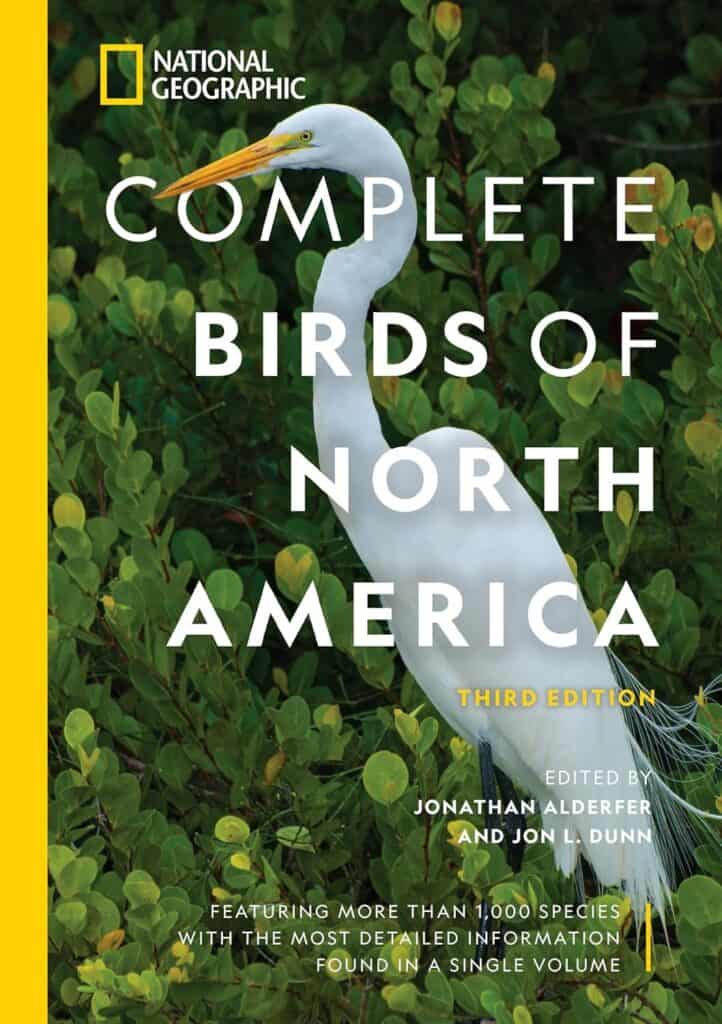
National Geographic Complete Birds of North America 3rd edition 2021
This book is labelled as the companion to the National Geographic Birds of North America described above.
We have not yet reviewed this book.
(M) Write a review
You must be logged in to submit a review.
Birds of North America
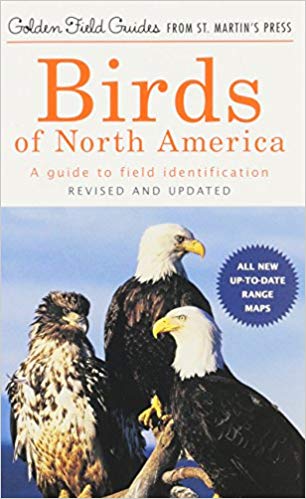
Golden Field Guides Birds of North America 2001
This has been one of the best-selling books on birds of North America since the first edition in 1966.
Although not as good as any of the above books, it is the only one small enough to actually be a field guide. The others are better classified as home reference books.
This little book describes all the birds of North America yet is small enough to carry in the field.
It follows the standard field guide layout with pictures on the right and text and maps on the left.
The drawings, maps, and text are good but a little smaller than other books, with five or six species per page. It follows the AOU checklist but does not indicate any similar species.
There is just one index for both English and scientific names, but it is alphabetically divided into sections, making it easy to use. Many guidebooks overlook this simple but very helpful feature. This is a quick index by family name inside the back cover, and there is a different colour tab for each family at the top of each page. However, there is no index for the colour code, which would have made the book simple to use. I wrote my own colour index inside the back cover (for example, red is for raptors, and purple is for waterfowl).
Additional Features
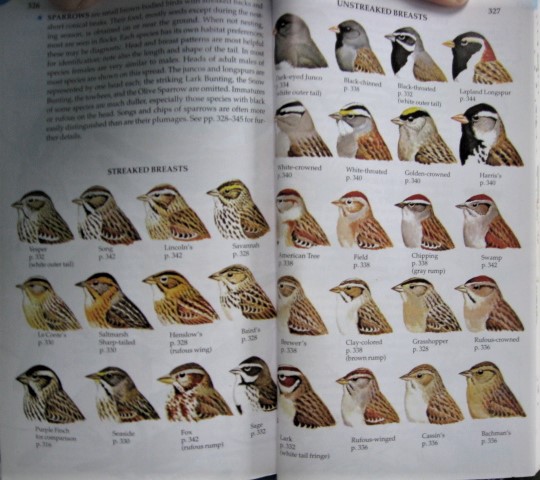
One really good feature of this book is the mini picture index at the beginning of each family section, which helps you narrow your search.
While not as good as the more extensive and expensive books, the Golden Field Guide is an excellent little book to keep handy in your car or backpack. Some of the more difficult species to ID, such as raptors and sandpipers, might require more research when you get home. It is not good enough to be your only guidebook, but adding it to your library is still recommended.
(M) Write a review
You must be logged in to submit a review.
Note. Most of the above publications refer to “North America” as Canada and the USA and do not include Mexico or anything south of the USA.
Birds of Western North America
The big books described above are excellent home reference books. However, you won’t be birding all over North America at once, so I think the guidebooks of either western or eastern North America are more practical.
Stokes Birds Western Region
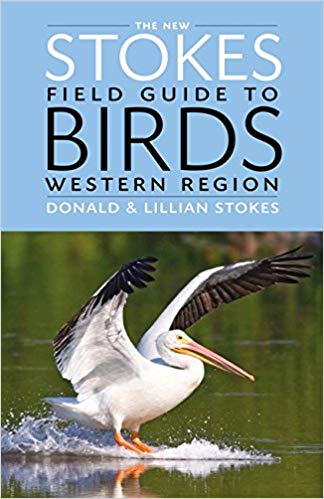
Stokes Birds Western Region 2013
It is an excellent book, with mostly one bird per page (a few pages have two birds on them). There are excellent photographs, sometimes as many as four and sometimes just one per species. There is lots of information and maps all at a glance on the same page.
(M) Write a review
You must be logged in to submit a review.
Sibley Birds West
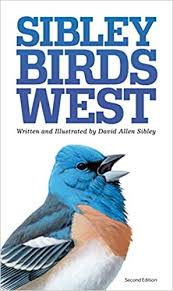
Sibley Birds West 2nd Edtion 2016
Like the large books described above, Stokes uses photographs, and Sibley uses drawings. Both are good, so it is a matter of preference. Better still, get both.
This book has two birds per page vs. one in the Stokes book. This is because there is less text information but more images, which is probably more helpful in the field. The birds are in column format instead of the usual birds on the left and text and maps on the right.
The images are small but very good, showing both standing and flying views. Although this book is about Western birds, the maps show all of North America. There is not as much text as in other books, and it does not point out similar species.
The book covers 700 species, including offshore birds up to 200 miles (320km) from shore. It uses the AOU checklist.
The index includes both English and scientific names. It is divided by letters of the alphabet, and family names are bolded, which makes this index very easy and quick to use. There is also a checklist to mark off birds you have seen. This checklist is divided by family names, so it can also be used as another index to look up families instead of individual species, which is a very useful feature. The first page for each bird family has mini pictures of the species in that family to help you narrow down your search.
Overall, this is an excellent book. You should have at least two bird books, and I recommend that this be one of them.
(M) Write a review
You must be logged in to submit a review.
Guide to Birds of Western North America
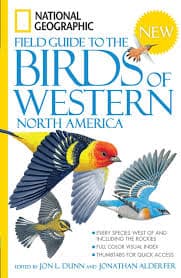
National Geographic Birds of Western North America 2008
This book is in the standard field guide layout with pictures on the right and text and maps on the left. The images are of very high quality and well-drawn. There is an average of four species per page, with several images of each bird showing different plumages.
The text is good and gives information on voice and range but not on similar species. It uses the AOU taxonomy.
There is one index for both English and scientific names with no divisions for alphabet letters and no bold family names, so the index is not as easy to use as some other books. It does have thumbnail indents for six of the most prominent bird families. So, the regular index is not so good, but inside the front cover are two quick indexes by bird family. One in text and one folding with pictures. This is really good for quickly finding the bird family you are looking for (Ducks to Woodpeckers are inside the front cover, and passerines are inside the back cover). There are a few pages for major bird families in flight such as hawks and sandpipers, however, these pages are located at the back of the family section. It would be better if it were placed on the first page of the family information.
This is another excellent book. In fact, all of these books are great, and it is a good idea to have several of them. You can’t go wrong with this book.
(M) Write a review
You must be logged in to submit a review.
Birds of North America Western Region
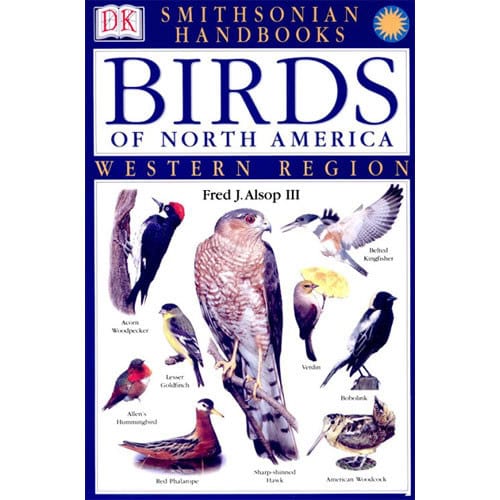
DK Birds of North America Western Region 2001
Considering that this book describes only the western half of North America, it is a monster book. It is the biggest of any described above, including those for all of North America. You will need a wheelbarrow if you take it into the field with you.
It is not suitable for lugging around in the field; however, it is a wonderful reference book. It is huge because there is only one species per page, and it contains tons of information you won’t find in other guidebooks.

The book uses photographs, not drawings; each photo is labelled with everything to look for to ID the bird. For example, the page for Hutton’s Vireo lists nine things to look for to ID this bird. The only drawback is that there is only one photo per species (a few have two), but it makes up for this by supplying a wealth of information you won’t find in other books. There are a whopping 750 pages. It features 696 species, including those within 200 miles of the coast. It follows the AOU taxonomic order.
In addition to the standard description, each page gives data on the species’ songs, behaviour, breeding habits, nesting, abundance or rarity, conservation status, what habitat to search for, and whether the bird is migratory. There are diagrams showing the flight patterns and a box telling how to ID the nest and eggs (it even tells you what the nest is made of and where it is usually built). One of the best features is that each page has a box showing all similar species. It even gives space at the bottom of the page to record sightings. The only bad thing about the data is that it provides the length, wingspan, and weight only in inches and ounces, which is okay for Americans but unsuitable for birders from the rest of the world.
Each species has a silhouette of the bird compared to the size of the book, so you can see exactly how big the bird is without having to imagine its size in inches or centimetres.
The index has English and scientific names divided by letters of the alphabet to help you search faster. The book is not divided by families.
Additional Features
At the beginning of the book, in addition to the regular information in every bird guidebook, there are pages on anatomy (such as different types of feet that birds have), information on variations within a species, two pages on tips on how to ID a bird, two pages of information about birds in flight, two pages on bird behaviour, and much more. There is even a four-page guide on extinct birds.
The back of the book includes a list of accidental and vagrant species that might be encountered and a small dictionary of bird terminology.
The book is well printed on quality paper and has a plasticised cover for protection.
The only serious flaw in this book is that the weights and measures are not given in metric. This is a great book, and every serious birder should have it in their library (either the eastern or western version) in addition to their favourite field guides.
(M) Write a review
You must be logged in to submit a review.
Guide to Birds of Western North America
Peterson Field Guide to Birds of Western North America 2010
It is an excellent book that is laid out in a typical fashion. I think the illustrations are brighter in colour than the actual birds. Write a review.
(M) Write a review
You must be logged in to submit a review.
Birds of Western North America
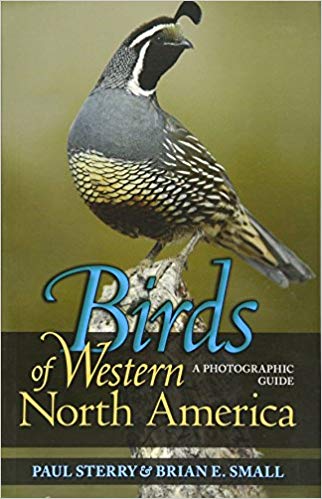
Princeton Birds of Western North America 2009
At first glance, this book seems the same as the others, with text and range maps on the left and bird photos on the right. However, it is not the same as any other field guide. All field guides have pictures of birds. Some of them use drawings, and others use photographs. Both are good and I think it is a matter of preference. If you prefer photographs over drawings, this is the book for you. To say that this book has good photos of the birds would be an understatement. The photographs are state-of-the-art and are some of the best I have seen. In addition, the images are much larger than bird photos in any other field guide. The birds can be seen in great detail. The publishers call this book a “Photographic Guide”, not a field guide. There are more photos on the text pages.
The text and maps are very detailed, with only two or three species per page. The text for each species is followed by “observation notes” that give additional information on where to find this bird and similar species that might be confused with it. For example, if you are looking for the Laughing Gull, it says, “For guaranteed sightings, visit the Gulf Coast. Otherwise, this species is most regular at the Salton Sea, California, mainly June to October.”
This is a great book, but no guidebook is perfect, and I have found a couple of faults. The measurements for some birds are given in length and others in wingspan, but not both. Also, the measurements are only in inches, which is very bad for readers from countries other than the USA (i.e., the rest of the world). Also, the book does not mention which taxonomic order it is following.
There is one index for both English and scientific names with no separation for letters of the alphabet.
Additional Features

There is no index by bird family names, but there is a bar across the top of every page that tells you the name of the bird family featured on that page. The page on the right, above the photographs, tells you the family name. If you are unfamiliar with the family names, on the left, you will see a sample photograph of a typical bird from that family and the scientific name of the family. This great feature makes it easy to skim through the book, looking for a particular bird family, without having to look it up in the index.
In addition to the regular Bird ID pages, there are two special sections of interest. At the front of the book is a 12-page section with photos that give information about plumage variation, bird habitats, migration, and more. At the back of the book is a 10-page section on vagrant species with photos and text. Many birds give this subject a one-page list or do not mention it.
The book is well made, with quality paper and a stiff cover that should keep it in good condition for many years.
Every serious birder should have at least two guidebooks and not rely on just one. With the best photographs of any field guide and the easy-to-use design and observation tips, this book is one of the best. It is highly recommended. It is worth buying just for the excellent photographs.
(M) Write a review
You must be logged in to submit a review.
Eastern North America
The Guidebooks to the Birds of Eastern North America are the same as their Western counterparts, except, of course, that they depict eastern species instead of western ones. Some birds are found all across North America and, therefore, would appear in both books.
Because of this, we will not describe the books again. We will just list them to allow you to make a review on them.
Stokes Birds Eastern Region
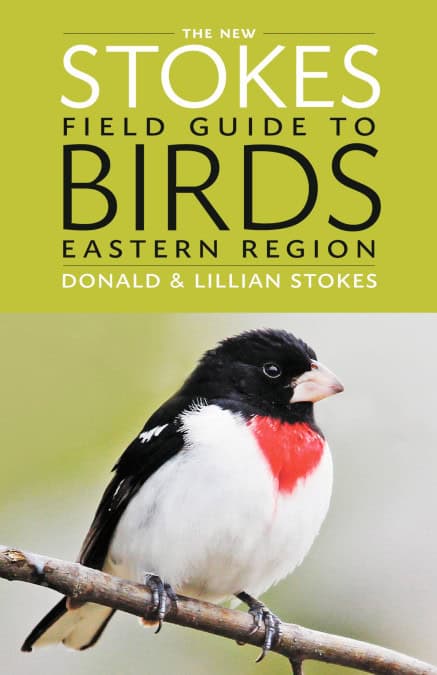
Stokes Birds Eastern Region 2013
(M) Write a review
You must be logged in to submit a review.
Sibley Birds East

Sibley Birds East 2nd edition 2016
hh
(M) Write a review
You must be logged in to submit a review.
Guide to Birds of Eastern North America
National Geographic Birds of Eastern North America 2008
(M) Write a review
You must be logged in to submit a review.
Birds of North America Eastern Region
DK Birds of North America Eastern Region 2001
(M) Write a review
You must be logged in to submit a review.
Birds of Eastern North America
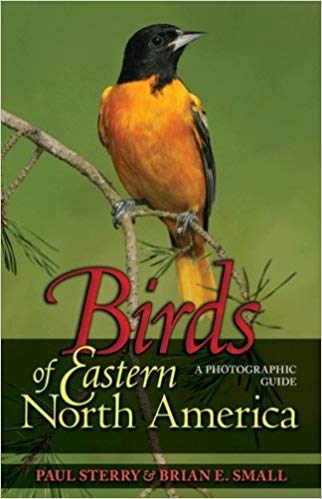
Princeton Guide of Eastern North America by Paul Sterry & Brian Small 2009
(M) Write a review
You must be logged in to submit a review.
Canada
Birds of Western Canada
Most bird guidebooks are designed for use in all of North America or either the western or eastern half. DK has recently produced a book solely for Canada, divided into eastern and western editions.
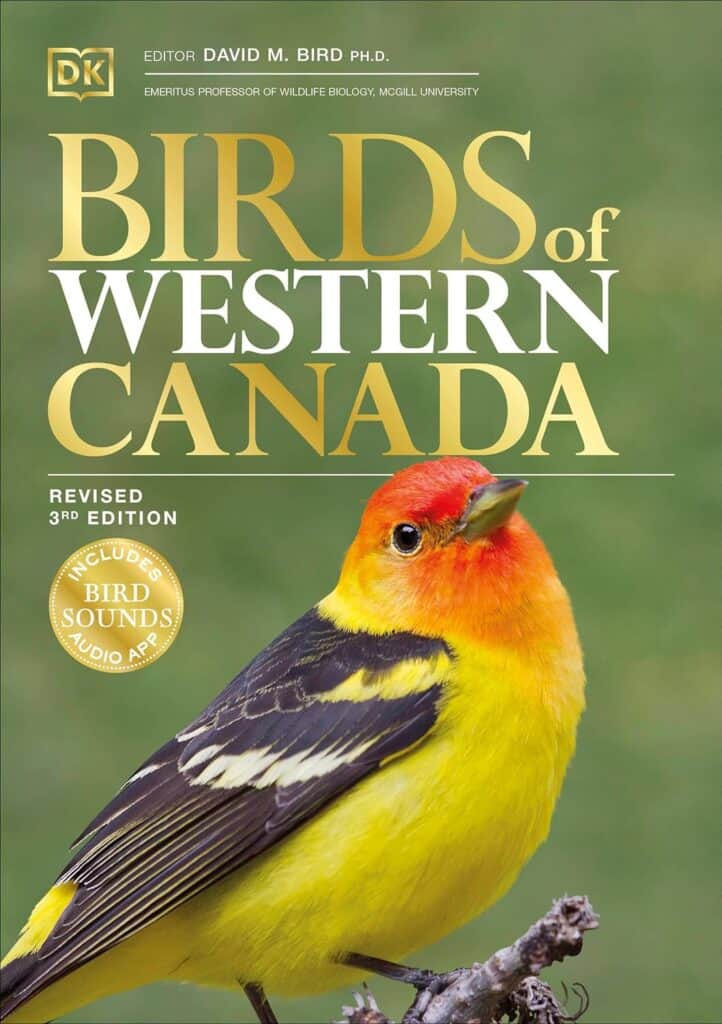
DK Birds of Western Canada 3rd edition 2023.
This book is for you if you bird mostly or entirely in Canada. DK bird guides are excellent, and this one is no exception. It is a little bit larger than the average field guide.
The updated 3rd edition includes the latest taxonomic data for 400 species.
Like the other DK guidebooks, it devotes a whole page to each species for 387 of the 400 species, with only the rare birds having more than one species per page. DK guidebooks give you more data about each species than any other publisher. The only drawback is that this makes the books relatively thick.
There is a very good text description of the bird and a distribution map. Although the book covers only western Canadian species, the maps show the distribution for all of North America, so you can see where else the bird can be found. The book covers 387 species plus an additional 13 species of rare visitors. These 13 species are at the back of the book, with four species on a page. It does not specify which taxonomic checklist it is following.
In addition to the usual information found in other guidebooks, for each species, it gives pictures of similar species, which helps to avoid ID errors. It also shows the flight pattern, specific things to look for to ID the bird and information on where the bird occurs in addition to the range map. At the bottom of each page is information on the length, wingspan and weight, social habits (in flocks or solitary, for example), the average lifespan and the conservation status.
There is one index for both English and Scientific names. The index is divided alphabetically with big, bold letters that help you quickly find the bird you seek. In addition, there is a coloured bar along the edge of each page with the name of the bird family on it, although there is no index for the colours or family names. There is also a glossary of birding terminology.
The book is printed on high-quality paper, and the cover is plasticized for protection, so it should wear well and last a long time.
Additional Features
Several pages at the front of the book provide great information about bird migration, courtship, mating, nests, eggs, and more.
The book features one species per page instead of the usual layout of several birds on the right and the text and maps on the left. Each page displays one large high-quality photograph of the species plus two or three small photos showing the bird in flight and other variations.
This edition includes a bird sounds audio app not in previous editions.
If you are birding in Canada, this is an invaluable reference. It is highly recommended.
(M) Write a review
You must be logged in to submit a review.
Birds of Eastern Canada
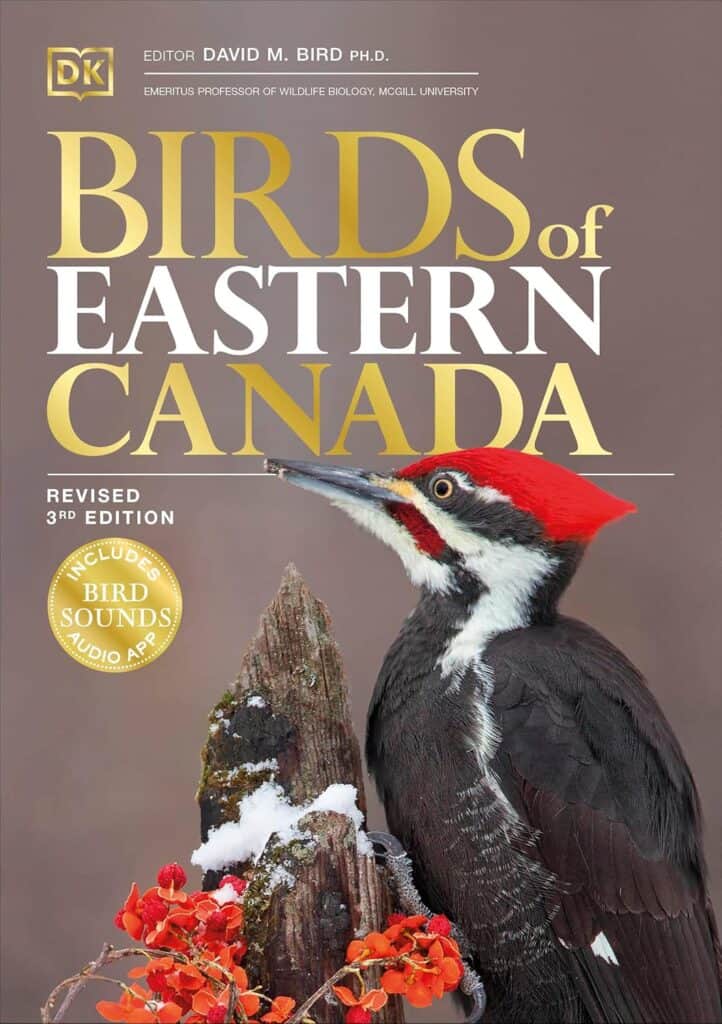
DK Birds of Eastern Canada 3rd edition 2023.
This is the same as the book described above but for the eastern half of Canada.
(M) Write a review
You must be logged in to submit a review.
.