
Penguins are adorable! At least the New Zealand penguins are. I have yet to see the tall ones in Antarctica. I have always wanted to see penguins in the wild (zoos and aquariums don’t count). So last winter (Canadian winter, summer in NZ), I visited New Zealand to see them and a few other birds (Kiwi, Kea, and others). There are 18 species of penguins. Six of them live in NZ. Of the six New Zealand penguins, three are relatively easy to find. The other three live on remote islands and are very difficult to get to see them.
Fiordland Penguin
The first penguin I searched for was the Fiordland Penguin (aka Fiordland Crested Penguin). They live in the southwest corner of the South Island. A good place to look for them is from Haast to Jackson Head along the coast. You can try the Monro Beach Walk or just past the little fishing hamlet of Jackson Head. Look for them early in the morning or after 3 p.m. when they are coming and going to and from the sea. They are resident here from June until November. Unfortunately, I got there after they fledged and went to sea, so I did not see any.
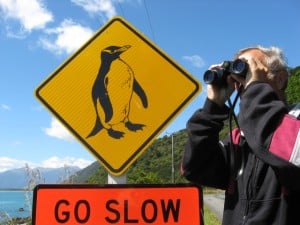
I moved on to Milford Sound, another good place to look for them, but again, no luck. A friend tried Doubtful Sound and saw a couple of them at a distance.
Another place to look for them is the northwest circuit tramping track on Stewart Island. They are fairly easy to find if you are there at the right time of year.
Yellow-eyed Penguin
I was very disappointed at not seeing the Fiordland Penguin but moved on to the Otago Peninsula near Dunedin on the other side of the South Island. You have a very good chance to see the Yellow-eyed Penguin and the Little Penguin there.
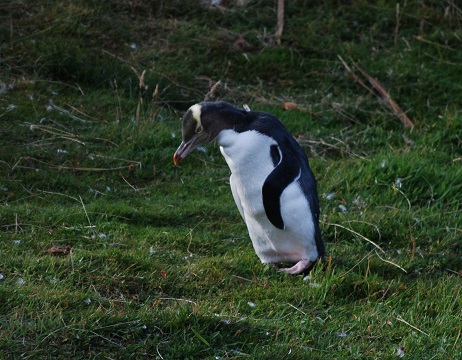
We looked first for the Yellow-eyed Penguin. Most penguins live in colonies called a creche. Of the 18 penguin species, the Yellow-eyed Penguin is the only one that does not live in a creche. In fact, they are quite anti-social. They come and go to the sea alone. When they mate, they go off with their partner and find a nesting place in the woods far from other penguins. I was lucky to see two of them coming out of the sea. Seeing one lone penguin on a long, sandy beach seemed quite strange. By entering and leaving the sea in groups, penguins share the risk of being eaten by a seal or orca. But the Yellow-eyed Penguin chooses to run the gauntlet on their own. Being one lone penguin is also an advantage in that a solo penguin would not attract too much attention compared to many of them.
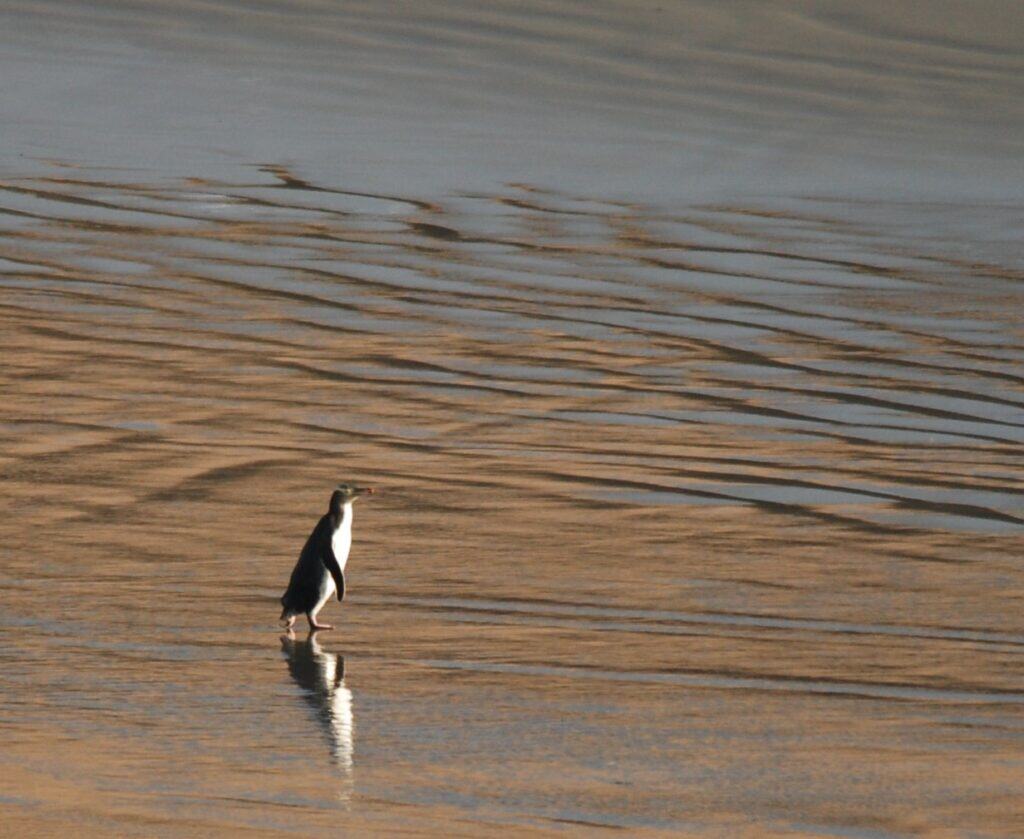
The Yellow-eyed Penguin stands 65 cm tall (25.6 inches) and weighs 5 to 6 kg (11 to 13 pounds).
They can be found at the southeast corner of the South Island, Stewart Island and the sub-Antarctic islands of Campbell and Auckland. As this species nests in the forest, habitat loss is a serious threat to them. Also, like all birds in New Zealand, many are killed by dogs and other introduced mammals. New Zealand has no native mammals except for bats.
The Little Penguin
I was thrilled to see the Yellow-eyed Penguin, but now the search was on for the Little Penguin. This penguin is known in New Zealand as the Blue Penguin or Little Blue Penguin.

The Little Penguins return after a day at sea
The creche of Little Penguins goes off to sea early in the morning to feed and return at dusk. Somehow they all manage to gather on the beach and head out to sea together. Nobody sleeps in late and misses the departure. We went to the beach at the tip of the Otago Peninsula at dusk to watch them return. It got dark, and still no sign of them. Perhaps they got lost? Then we saw something large and dark in the water about a kilometre away. It looked like a whale. The large dark thing slowly approached the shore. It curved back and forth like a giant snake. What could it be? It turned out the be the creche of Little Penguins. All these small penguins swimming close together in a group looked like a whale from a distance.
We waited in anticipation for them to come up the shore. The shore at this point was not a sandy beach but a large pile of big rocks. The penguins had to climb over them. Hundreds of them walked past us just several metres away. It was wonderful!
The appropriately named Little Penguin is the smallest of the 18 penguin species. These little guys stand just 25 cm (9.84 inches) tall and weigh only one kilogram (2.2 pounds). You can see how tiny they are when you compare their measurements to the Yellow-eyed Penguin. And the Yellow-eyed is only a medium-sized penguin. The Emperor Penguin, which lives only in Antarctica, is 122 cm (48 inches) tall and weighs 22 to 45 kg (49 to 99 pounds).
I was supervised by how noisy they were. Perhaps they should be called the Little Noisy Penguins. After they got up the hill, they separated and went into their underground burrows for the night. I imagine they slept well after swimming all day, climbing over the rocks and up a large hill.
Other New Zealand Penguins
You should be able to find at least two of these three penguin species, all three if you are there at the right time of year. The other three New Zealand penguins are more challenging to see.
The Snares Penguin (called the Snares Crested Penguin in NZ) lives only on the Snares Islands, about 200 km south of the main NZ islands. Landing on the islands is prohibited, but they can be viewed from a boat around the islands from October to February.
The Southern Rockhopper Penguin can be found in the Campbell and Auckland Islands, but this species can be better seen in Chile, Argentina, or the Falkland Islands.
The Erect Crested Penguin lives only on the Campbell, Auckland and Antipodes Islands. Cruise ship tours go to these sub-Antarctic islands, but it is pretty expensive. Ask a travel agent in New Zealand.
Tiri Tiri Matangi Island
Back up on the North Island again; I took a boot tour from Auckland to Tiri Tiri Matangi Island. This island is a bird sanctuary and a great place to see Takahe, Kiwi, and Little Penguins. You probably will not see any penguins during the day, but it is possible to arrange an overnight stay on the island (arrangements must be made in advance with the Department of Conservation). There are many visitors during the day, but after the ferry leaves at 3 p.m., there will be just a handful of people on the island.
We walked down to the beach after dark, looking for kiwi. We did see one Kiwi and then continued to the beach. As we approached the coast, we saw two Little Penguins coming up the trail toward us. We stopped and stood very still. They walked right past us, stopped about two metres away and stayed there for several minutes looking around as if deciding which way to go (it was a junction of two paths). Unfortunately, it was dark, and we were looking for Kiwis, not penguins, so I didn’t bring my camera.
I am usually not a sentimental guy, but this was a special moment that I will always treasure. You can have a great holiday seeing all the sights of New Zealand and looking for the many unique birds, but the best part of my trip was seeing the New Zealand penguins.
Great post! I bet seeing the creche of Little Penguins coming under the sea must have been thrilling.
Too bad you weren’t carrying your camera when encountering the Little Penguins in the trail. Still, I bet it was a great feeling!
Thanks, Airan. Yes, I love penguins. Seeing the little ones is one of my fondest memories. I hope to see another species of Penguin soon in Galapagos. Tom