Purple Martins could use your help with a housing shortage.
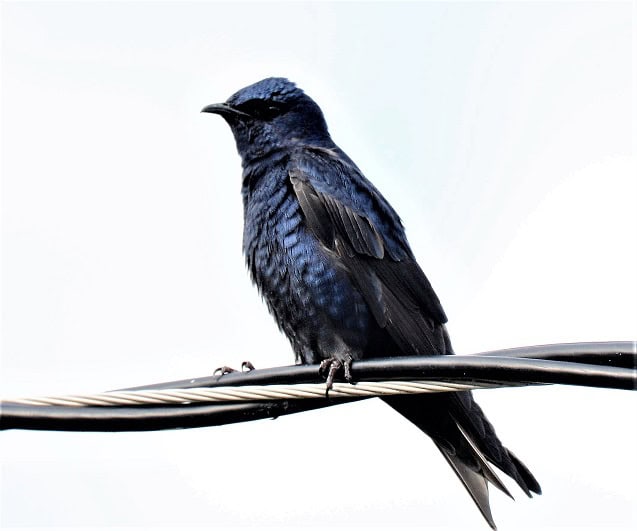
The Purple Martin is a bird in the swallow family, although it differs slightly from your average swallow. They are the largest member of the family, with an average length of 20 cm (7.9 inches) from bill to tail.

They are like tiny military aircraft with their swept-back wings, forked tails and glossy, metallic purple colour. They sometimes fold in their wings and dive at incredible speeds. Females and juvenile birds are more grey than purple.
Cavity Nesters

Purple Martins are cavity-nesting birds. At one time, they must have nested in hollow trees. But today, they rely almost entirely on human-made condo-style houses.
Birds that nest in cavities experience a housing shortage that birds building their own nest of sticks or mud do not have. Other cavity-nesting birds include Bluebirds, English House Sparrows, European Starlings, Owls, Woodpeckers and Wrens. Woodpeckers have an advantage over other cavity-nesting birds in that they can excavate their own homes. Other birds have to search for a suitable site. House Sparrows and Starlings are introduced birds from Europe and are more aggressive than North American birds. They will kill Purple Martins to take over the nesting cavity. House Sparrows also kill Wrens and Bluebirds in competition for suitable cavities.
Migration
Purple Martins migrate to South America in the winter. They arrive in the southern USA in January but do not reach Canada until mid-May. The males usually arrive before the females.
Diet
Purple Martins feed on flying insects. A colony near your house would be a good thing. Without them, there would be a much larger number of mosquitoes and other flying insects around your home.
Song
Purple Martins can be quite nosy at times. Their song is not sweet like a canary or a meadowlark but is more of a throaty rattle and croak. However, I enjoy their songs in the morning.
You Can Help
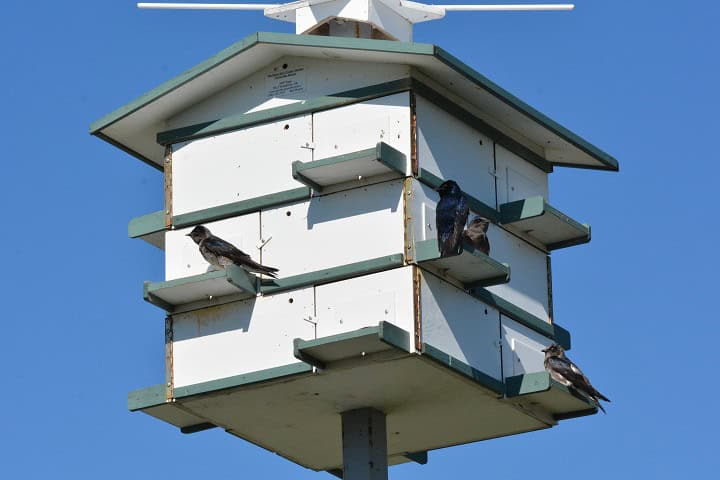
You can help the Purple Martin by erecting a home for them. The condo-style house is the most common but they will also nest in natural or artificial gourds. Don’t allow House Sparrows or European Starlings to evict the Purple Martins and take over their nests. If other cavity-nesters occupy the house before the Purple Martins arrive, evict them. The Purple Martins will not be able to do it without your help. Take down the house during winter and do not put it up again until about three weeks after the first Martins arrive. Putting it up too soon may result in occupation by other birds.
Purple Martin Conservation Association
Click here if you want to establish a Purple Martin colony on your property or to get more information about them.