Where to see Birds on Migration.
Would you like to see Arctic birds without going to the Arctic? You can. Migration hotspots are the best places to see birds during their spring and fall migration. Remember that the birds are not in these locations all year round. These are the best locations to find birds when they stop for rest and food during migration.
While some hotspots might be used during spring and fall, some locations are better in the spring, while others offer better birding on the fall migration.
Abbreviations
- NP – National Park
- SP – State Park
.
North America – Canada & USA
- Point Blue Conservation, California-– formerly called Port Reyes Bird Observatory
- Bear RiverMirgraotry Bird Refuge, Utah–Geese and ducks arrive in early March. Shorebirds April to mid-May. During fall migration, July to mid-Aug, there will be half a million ducks and geese here. There are 30,000 Tundra Swans from mid-Oct to Dec.
- Hawk Ridge Bird Observatory, Minesota–Hawk migration Sep and Oct. Best 10-25 Sep. You can see thousands of hawks flying over, but not close enough for photography. Bring binoculars and a chair.
- Whitefish Point Bird Observatory, Michigan
- The Aleutian Islands
- Copper River Delta, Alaska
- Gray’s Harbour NWR, Washington –huge amounts of Sandpipers and Plover from late Apr to mid-May. A shorebird Festival is held the last weekend in April. Not as good in the fall.
- Tule Lake NWR, California
- Freezeout Lake, Montana
- Devil’s Lake, North Dakota
- Derby Hill Bird Observatory, New York–Like Hawk Ridge, this is another place to observe the hawk migration. About 40,000 hawks pass overhead in Mar, Apr and May, with Apr being the best.
- Cape May, New Jersey—Thousands of birds stop here in the fall. Watch for Mourning Warbler and American Pipit in the Spring and Swainson’s Warbler and Wayne’s Warbler in the Fall.
- Florida Keys. Best places in the Florida Keys: National Key Deer Refuge, Dagny Johnson Botanical SP, Long Key SP, Dry Tortugas NP, John Pennekamp Corel Reef SP, and Curry Hammock Good for migrants and pelagic birds.
- Churchill, Manitoba—Best in the first two weeks of June. Warning: Polar Bears inhabit the area, mainly in November, but walking far from a vehicle is not a good idea unless you are in a group with an armed guide. Eagle-Eye Tours offers biding trips.
- Platte River, Nebraska— Half a million Sandhill Cranes stop here in the spring. Very impressive. Lots of other bids stop here as well. Best in late March.
- Cheyenne Bottoms, Kansas–25 to 50 thousand sandpipers in spring. It’s not as good in the fall.. Peak time is 1 to 24 May.
- Aransas NWR, Texas—This is the best place in North America to see whooping cranes. See Arctic Birs Migration and Birding Hotspots USA. It is not a stopover. The cranes are here all winter. They are closed on Mondays, Tuesdays, and federal holidays.
- Point Pelee NP, Ontario–Best place to see Warblers in North America. Warblers are in almost every bush during the first two weeks of May. Also, there are many other songbirds, and often, a fallout occurs after a stop. Rare birds are also seen here more often than in any other place in North America. There is a Songbird Festival in May. Book far ahead for accommodations. Point Pelee is one of the best birding hotspots in North America. See Birding Hotspots Canada.
- Bombay Hook & Prime Hook NWR, Delaware
- Machias Seal Island, New Brunswick–5,000 pairs of puffins, 1,000 pairs of Razerbill Auks, 500 pairs of Murres and many pelagic birds can be seen here. The island is claimed by both Canada and the USA. Getting there is difficult. Sea Watch Tours have exclusive access to the island, but only 15 people per day are allowed to land. The island is ten miles SE of Cutler, Maine, but tours start from Grand Manan Island in Canada.
- St. Paul Island, Alaska–200,000 birds in late spring, often including rare species from Asia..
- Bonaventure Island & Pierce Rock, Quebec–Good in Spring for many species of alcids, gulls, puffins, Great Cormorants and Blackpole Warbler.
Central America
- San Blas, Nayarit, Mexico
- Rio Lagartos, Yucatan, Mexico–Flamingos, Black Hawk, Snail Hawk, Wood Stork, and Boat-billed Heron. See Birding Hotspots Mexico
- Panama Canal Zone
South America
- Paracas National Reserve, Lima, Peru.–Lots of sandpipers here as well as Chilian Flamingo and Peruvian Tern, Peruvian Boobyk Red-legged Cormorants, Inca Tern, Peruvian Pelican and the endangered Humboldt Penguin.
- Lagoa do Peixe NP is located on a spit in southern Brazil, near the border with Uruguay.
- Punta Rasa, Argentina–Flamingos, Parasitic Jaeger, Olrog’s Gull, Snowy-crowned Tern and many others.
Europe
- Fair Isle, Scotland–A remote island north of mainland Scotland. Different bird species are seen each month of the year. Accommodations are available.
- Falsterbok, Sweden— Spring
- Hanko, Finland–Spring
- Isles of Scilly, England— Reliable in Fall for Red-breasted Flycatcher, Yellow-browed Warbler and Pallas Warbler.
- Donana NP, Spain— Good for Spanish Imperial Eagle, Marbled Teal, Red-knobbed Coot and maybe an Iberian Lynx.
- Strait of Gibraltar–Between Gibraltar and Africa. Best in Mar and Sep. It is one of the best places in the world to see the raptor migration. More than a quarter million raptors pass daily at peak migration. Tours are available from Ronda, San Pedro de Alcántara, Estepona, or Tarifa in Spain.
- Camargue Regional Park, France–Spring 50,000 flamingos. Also, Short-toed Eagle and many others.
- Lake Neusiedler, Austria–Best Apr, May, Aug, and Sep.Eastern Imperial Eagle, Great Bustard, Pygmy Cormorant, Hoopoe, Barred Warbler, Moustached Warbler, River Warbler, and many others.
- Hortabagy NP, Hungary–Best in fall. There are lots of waterfowl, Imperial Eagle, Saker Falcom and thousands of Common Cranes.
- Danube Delta, Romania–inaccessible by road. Take the ferry to Salina.
- Strait of Bosporus, Turkey–best viewing at Sarıyer Feneryolu Birding Tower north of Istanbul. See Lesser Spotted Eagle, Greater Spotted Eagle, European Honey Buzzard, Short-toed Snake Eagle, Imperial Eagle, Sparrowhawk, Black Stork and many others.
- Strait of Messina, Italy–Between Sicily and mainland Italy. Best Mar, Apr, May. Europen Honey Buzzard, Western Marsh Harrier, Mantagu’s Harrier, Pallid Harrier, Eurasian Hobby, Black Stork, and others.
- Bear Island, Norway—This tiny island between the north coast of Norway and Svalbard has the largest seabird colony in the Northern Hemisphere, including 1.5 million birds of 126 species. The island is very remote and not available for individual travel. You can go with HX Hurtigruten Expeditions. You would not want to be there alone anyway. It is not called Bear Island for nothing.
- Lake Hornborgasjon, Sweden–Thousands of birds here in both spring and fall, including Hen Harrier and Black-necked Grebe
- Morecambe Bay, England–240,000 birds each spring, including Little Tern and Arctic Tern. Best March to July.
- Waddenzee NP–more than 12 million birds stop here on migration, including the entire population of Pink-footed Geese. Take a tour of go on your own. The best spots are Mando, Romo, and Tondermarsken. It is located on the north coast of Europe at the border between the Netherlands and Denmark.
- Island of Texel, Netherlands— located at the entrance to Waddenze
- Helgoland Island, Germany— North of Germany in the North Sea. Good both Spring and Fall. Oct best for sigting of Yellow-browned Warbler, Pallas Leaf Warbler, Rosy Starling, Little Bunting, Lapland Bunting, and Richard’s Pipit are common.
- Usselmeer, Netherlands–A large bay on the north coast near Amsterdam. Ducks, geese, grebes, gulls, terns, and large wading birds.
- Matsalus NP, Estonia–Two million waterfowl here each spring.
- Varangerfjord, Norway—Seabirds include Kittiwakes, Puffins, and sea eagles in March. It is probably the best place to see Steller’s Eider.
- The Wash, England–lots of shorebirds and waterfowl
- Camargue Regional Nature Park, France–Spring migration of European Bee-eaters and Eurasian Hoopoes returning from Africa.
- St Ives, England–Great for close views of seabird migration in Aug. Species include Gannets, Auks, Manx Shearwater, Balearic Shearwater, Sooty Shearwater
Africa
- Bank d’Arguin NP, Mauritania—More than one million migratory birds come from northern Europe, Siberia, and Greenland. However, many birds are on sandbanks, making sighting them difficult. The park offers tours.
- Senegal Delta
- Lake Chad–Located at the junction of four countries: Chad, Nigeria, Niger, and Cameroon.
- South Luangwa NP, Zambia— Many birds along the river bank, including Fish Eagles.
- Zambezi NP, Zimbabwe–Ndar Victoria Falls. Rock Pratincole, Schalow’s Turaco, African Finfoot, Half Collared Kingfisher, Thick Billed Weaver, African Skimmer, Pels Fishing Owl, Collared Palm Thrush and Western Banded Snake Eagle
- Mosi-oa-Tunya NP, Zaire. Across Victoria Falls from Zimbabwe. Taita Falcon, African Finfoot, and Brown Firefinch
- Moremi Game Reserve, Botswana–African Fish Eagle, Southern Carmine Bee-easter, Black-chested Snake-eagle, Martial Eagle, Pel’s Fishing Eagle, Wattled Crane. Best in April.
- Nylsvley Nature Reserve, South Africa–Up to 80,000 birds at a time, including Cape Vulture nesting, yellow-throated Sandgrouse, Blue Crane, Barrow’s Korhaan and Stanley’s Bustards
- Langebaan Lagoon, West Coast NP, South Africa
Middle East
- Azraq, Jordan–Spring and Fall. Hot in summer.
- Eilat, Israel–Migrants and desert birds
Asia
- Mai Po Nature Reserve, Hong Kong–See Birding Hotspots Hong Kong
- Kyzylagach NP, Azerbaijan–Abundance of migratory birds of all kinds.
- Bharatpur Bird Sanctuary, India–Abundance of migratory birds, including Greater Spotted Eagle and Imperial Eagle.
Australia and New Zealand
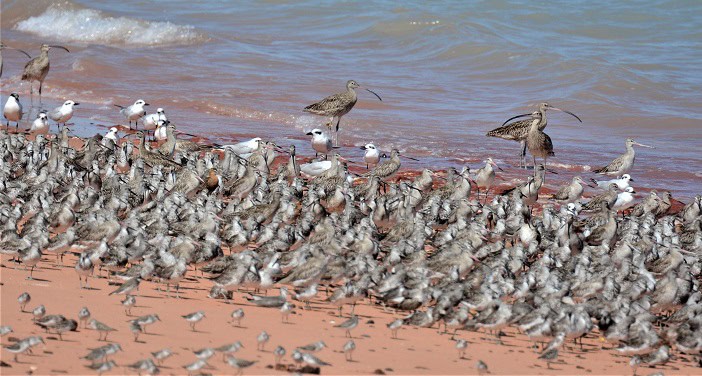
- Broome Bird Observatory, Western Australia–Perhaps the best birding site in Australia. 150,000 shorebirds, including the huge Far-Eastern Curlew and birds that nest north of the Arctic Circle. They stop on the coast near Broome from Mar to May and return between Aug and Oct. The site is remote, and the sand road is best travelled in 4WD. You can arrange for them to pick you up in Broome. Inland at the observatory, you will find several species of bowerbirds and their bowers, and perhaps bee-eaters. Accommodations are available. The observatory is closed during the wet season from December to February. There are also some birding opportunities in the town of Broome.
- Eighty Mile Beach, Western Australia–Another shorebird stopover similar to Broome. It is located on the NW coast, about 200 km from Broome.
- Shark Bay, Western Australia–65 species of migratory birds plus residents such as Emu, Western Grasswren and Spotted Scubwren.
You may encounter duck hunters in some of these locations that are not parks.