Australia’s Majestic Raptor
Birdtripper profile – The Wedge-tailed Eagle
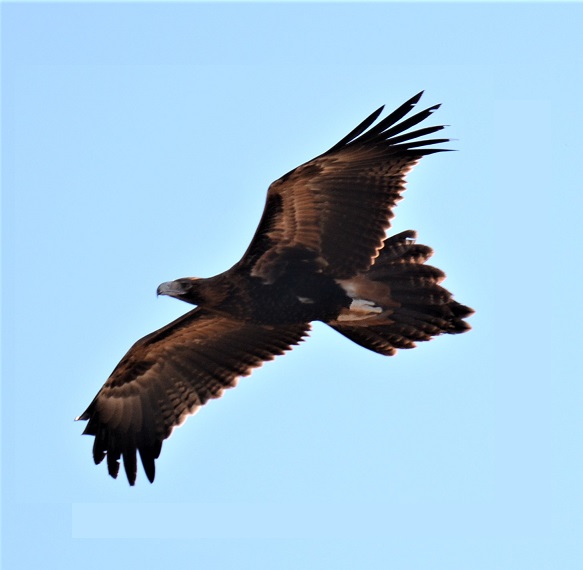
Periodically, Birdtripper will feature one of the world’s most amazing birds. This time we profile the majestic, impressive Wedge-tailed Eagle. You can identify them in flight by the wedge shape of their tail, after which it is named.
Basic Facts
- The Wedge-tailed Eagle has the largest wingspan of Australia’s 24 raptors.
- The bird is named for its unmistakable wedge-shaped tail which is visible when in flight.
- The wingspan can be up to 2.84 metres (9 feet 4 “)
- The length is about 1.06 metres (3 feet 6′)
- The weight can be 3 to 5.8 kg (6.6 to 12.8 lb) for the larger females
- 2 to 4 kg (4.4 to 8.8 lb) for the males.
- They are dark brown, getting darker as they age.
- The Wedge-tail often soars on thermals for hours without flapping its wings.
- They mate for life.
Nesting
Their nests can be up to 2.5 metres wide and 2.6 metres in height. They usually lay two eggs. The young depend on their parents for up to six months and may hang out with them for a further six months before making a life of their own.
Where to Find Them
They live throughout most of Australia except in desert regions and Cape York. The most likely place to see one is on the Nullarbor Plain in the country’s south. They also live in Papua-New Guinea and Indonesia.
What they eat
The Wedge-tailed Eagle captures its prey by swooping down on them unexpectedly from a great height.
The Wedge-tailed Eagle preys mainly on the introduced rabbit, which is good as rabbits do not have natural predators in Australia. Their population can get out of control. They also take feral cats, of which there are plenty in Australia. This is also good at wild cats are killing millions of Australia’s birds and small reptiles.
Before the arrival of Europeans, their natural prey was wallabies, possums, koalas and bandicoots, and they still eat these animals, but rabbits and cats are more plentiful and easier to catch.
They also feed on carrion. Sometimes they gorge themselves so much on roadkill that they have difficulty taking off. In this bloated condition, they can still fly but are very slow to gain lift and are often hit by trucks.
Conservation Status
They are classified as “Least Concern” and are protected in Australia.
They have no natural predators but are threatened by logging, poison bait intended for dingos, collisions with wires and fences and being hit by vehicles whilst feeding on roadkill.

Where to find them
The Wedge-tailed Eagle might be seen almost anywhere in Australia. However, I have travelled all over the continent and the only place that I saw any number of them was in the Nullarbor, which is a very remote, treeless area in the south of central Australia. They are more common in Tasmania than on the Australian mainland.
If you know of a good place to see Wedge-tailed Eagles, let us know in the comments section.
Other Eagles in Australia
There are two other eagles in Australia. The Little Eagle, as its name implies, is only half the size of the Wedge-tailed Eagle. The White-bellied Sea Eagle is black and white and is unmistakable. However, they look similar to Wedge-tailed Eagles when they are young. You can tell the difference by that unique tail.
