Hawaii is sometimes called the endangered species capital of the world. Of the 65 endemic birds, only two are not extinct or in danger of extinction. Twenty-three are extinct. Five have not been seen in years and are probably extinct but have not been officially declared yet.
The Hawaiian Islands are divided into two groups. The main islands consist of the island of Hawaii, Maui, Lani, Molokai, Oahu, Kauai, and the two tiny islands of Kahoolawe and Nihau.
The second group is located far to the northwest. They are spread out in a chain of more than 120 tiny islands and atolls over almost 2,000 km (1,200 miles). All of them are uninhabited. In 2006, the Northwest Islands were declared a National Monument (similar to a National Park but at a lower status level). It is 222 km (138 miles) from the main islands to the closest island in the Northwest chain.
Laysan Island Rabbits
Laysan is the second-largest island in the Northwest Islands (after Midway). It is 1.5 miles in length and one mile wide (2.4 by 1.6 km), with a large lake in the middle of it, which takes up about 15 per cent of the island.
In the 1800s, feather hunters killed thousands of birds, but this was minor compared to what followed. In 1903, there were ten million birds on Laysan. By 1911, there were less than one million.
In 1894, rabbits were introduced to Laysan to create a meat-canning industry. Having no predators on the island, the rabbits multiplied as rabbits do. They ate all the vegetation on the island. Without plants, the topsoil blew away. After eating all the plants, the rabbits began to starve to death. By 1918 there were only 100 rabbits left, and 26 plant and two bird species were extinct. The remaining rabbits were exterminated in 1923, but it was too late for many birds.
The Laysan Rail and the Laysan Honeycreeper are now extinct as a result
Two other Laysan birds are hanging on.
- Laysan Duck CR Once abundant, by 1912, the population was just 12 birds. After getting rid of the rabbits, by 1950, the population was up to 500. By 2004, the population was 576 and 42 were transferred to Kure Atoll and Midway Atoll. The current population is above 600. and increasing, but they are still classified as Critically Endangered. The Laysan Duck escaped joining the Laysan Rail and the Laysan Honeycreeper in extinction by only 12 birds.
- Laysan Finch VU Endemic to Layson Island and found on Midway, Kauo, Perl and Hermes in the Northwest Islands Group. Population 1,500 to 7,000 and stable. This species is in danger due to its limited range on a few small exposed islands and atolls.
Causes of Extinction
Other than rabbits on Laysan Island, the significant causes of bird extinction are as follows:
- Habitat Destruction. Some species could not survive without their native plants.
- Cattle. After cutting down the trees, cows trampled what was left of the vegetation.
- Lack of Food. Habitat destruction also caused the insects that lived on the plants to disappear.
- Invasive Species. Rats, cats, dogs, pigs and mongooses are the leading causes of bird extinction.
- Mosquitoes. Introduced mosquitoes brought with them Avian Flu and Avian Malaria.
- Hunting. Hunting killed many birds but was not the leading cause of their extinction.
- Feather Collecting. The native Polynesians made capes for their kings from bird feathers. Predominantly red and yellow ones. Imagine how many little birds were killed to make one cape.
- Collectors. In the 1800s, it was common to kill birds for personal or museum collections.
An Entire Family Wiped Out
The Mohoidae was a bird family that consisted of five species of insectivorous songbirds. The only case of an entire bird family going extinct.
- Kaua’i ‘OO – from the Island of Kauai. Extinct 1987.
- O’ahu ‘OO – from the island of Oahu. Extinct 1837.
- Bishops OO – Endemic to islands of Molokai, Maui and Lanai. Extinct 1904
- Hawaii OO – Island of Hawaii. Extinct 1934.
- Kioea – Island of Hawaii. Extinct 1850
Hawaii Endemic Birds – Extinct
Rails – 2 species
- Hawaiian Rail – Endemic to the Island of Hawaii. Extinct 1884.
- Laysan Rail – See Laysan Island above.
Thrushes – 2 Species
- Kama’o. – From the island of Kauai. Last seen in 1989.
- Amaui – From the island of Oahu. Extinct about 1850. Only one specimen was ever collected, which is now lost.
Hawaiian Finches – 19 Species
Some of these birds are more like Honeyeaters than Finches but are classified in the family Fringillidae (finches). Some have long, curved bills for eating nectar.
- Lana’i Hookbill – Endemic to the island of Lanai. Extinct 1918.
- Kaua’i Palila. – Known only from fossils. Extinct before 1900.
- Lesser Koa Finch. – From the island of Hawaii. Extinct in 1891, after the Koa trees, which they needed to survive, were destroyed by cows. The last two were shot.
- Greater Koa Finch – From the island of Hawaii. Extinct 1896 for the same reason as Lesser Koa Finch.
- Kona Grosbeak – Endemic to Naio. Extinct 1894. Known only from fossils.
- Kaua’i ‘Akialoa – Endemic to Kauai. Extinct in 1967, mainly from Avian Malaria.
- O’ahu ‘Akialoa – Edemic to Oahu. Last seen 1940.
- Maui Nui ‘Akialoa – Endemic to Lanai, Kahoolawe, Maui and Molokai. Extinct 1892.
- Lesser ‘Akialoa – From the island of Hawaii, Extinct 1940.
- Greater ‘Amakihi – From the island of Hawaii. Extinct 1901.
- O’ahu Nukupu’u – From Oahu. Extinct 1890.
- Giant Nukupu’u – Known only from fossils. Extinct before the arrival of humans. Cause unknown.
- Kakawahie – From island of Molokai. Last seen 1963. The leading cause of extinction was feather collection for capes. Habitat destruction and mosquitoes finished them off.
- O’ahu ‘Akepa – From Oahu. Extinct 1930.
- ‘Ula-‘ai-hawane – From the island of Hawaii. Last seen 1892. They fed on the fruit of the Loulu Palm tree. Destruction of these trees caused their extinction.
- Hawaii Mamo – From the Island of Hawaii. Last seen in 1898. The main cause of extinction was feather collection for capes. This bird was primarily black with yellow on the rump and under the tail and a bit on the shoulder. Imagine how many were needed to make a yellow cape. A species collector shot the last bird.
- Black Mamo – From Molokai. Discovered in 1893 and last seen in 1907 due to habitat destruction and cattle.
- Po’ouli – From Maui. The population in 2004 was two birds, and they have not been seen since.
- Laysan Honeycreeper. – See Laysan Island above.
Hawaii Endemic Birds – In Danger of Extinction
There are several levels of classification for endangered species as follows:
- LC – Least Concern. A species that is not in danger of extinction
- NT – Near Threatened This species might become in danger of extinction.
- VU – Vulnerable A species in danger of extinction if something is not done soon.
- EN – Endangered. A species that is likely to become extinct in the future.
- CR – Critically Endangered. A species on the brink of extinction.
- EW – Extinct in the Wild. This species exists only in captivity
- PE – Possibly Extinct. This species is not officially declared extinct yet but has not been seen in many years.
Here are Hawaii Endemic Birds that fall into one of the above categories
Waterfowl
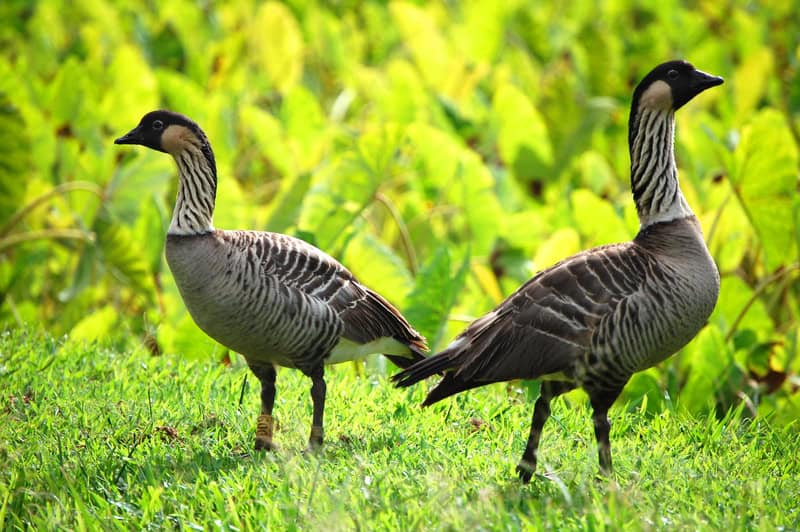
- Hawaiian Goose (Nene) NT All islands. Population 17000 to 22000 and increasing.
- Hawaiian Duck EN All islands. Population 1,500 and decreasing
- Laysan Duck – See Laysan Island above.
Hawks
- Hawaiian Hawk NT The Island of Hawaii only. The population is 1,100 and stable.
Rails
- Hawaiian Coot VU. All islands. Looks almost the same as the American Coot. The population is 1,300 to 2,700 and stable.
- Three other species of Hawaiian Rails are extinct (see above).
Corvids
- Hawaiian Crow EW. This species is extinct in the wild and exists only in captivity. Their population was reduced by introduced species and avian malaria from introduced mosquitoes. The current population is 114. It is planned to release some of them back into the wild eventually. Since 2009, the U.S. government has spent 14 million dollars preparing suitable and safe habitats for their release.
Monarch Flycatchers
- Kaua’i ‘Elepaio VU. Endemic to the island of Kauai. Population 20,000 to 50,000 and increasing.
- O’ahu ‘Elepaio EN Endemic to the island of Oahu. Population 1,261 and decreasing.
- Hawaii ‘Elepaio VU Endemic to the island of Hawaii. Population 52,00 and increasing slightly.
Old World Warblers
- Millarbird CR Endemic to the tiny island of Nihoa in the Northwest Islands group. The population is 250 to 1,000. Some have recently been transferred to Laysan Island. There were previously two subspecies, but one is now extinct, leaving only one type of Millerbird. Sometimes called the Nihoa Millerbird.
Thrushes
- Puaiohi CR Endemic to the island of Kauai. Population 400 to 580. This bird has never been abundant. In addition to the usual reasons for the decline, 75 per cent of the remaining population lives in a tiny area of only four sq miles (ten sq km) on the side of a mountain which could be wiped out in a storm. They would be safer if they were spread out more.
- Oloma’o CR PE Formerly existed on Oahu, Maui, Lanai and Molokai. Last seen on Oahu in 1850, Lanai in 1933 and Molokai in 1980. Probably Extinct.
- ‘Oma’o VU Endemic to the island of Hawaii. Population 170,000, and stable, The problem with this species is that all of them are concentrated in a small area which makes them vulnerate to storms and volcanos in addition to the usual problems.
Finches
Some of the following birds have long, downward-curved bills and feed on nectar, which makes them look like Honeycreepers and one is a creeper. However, they are classified in the Fringillidae (Finch) family.
- Nihoa Finch CR Endemic to the island of Nihoa in the Northwest Islands Group. Population 2,400 to 3,600.
- ‘O’u CR PE Formerly abundant on all islands. Now possibly extinct. Last seen in 1989. In addition to the usual causes of extinction, most of the remaining birds were driven from their usual habitat in 1984 by lava flow from a volcano.
- Palila CR Endemic to the island of Hawaii. Population 1,000 to 2,500 and decreasing.
- Maui Parrotbill CR Endemic to the island of Maui. Population 250 to 540 and decreasing. Has a short, very thick, sharply downcurved bill.
- O’ahu ‘Amakihi VU Endemic to the island of Oahu. Population 13,000 to 40,000 and stable. Has a short, thin, down-curved bill.
- Kaua’i ‘Amakihi VU Endemic to the island of Kauai. Population is declining rapidly. The population in 2000 was 51,800. By 2018 this was down to less than 7,000. Like other Amakihis, it is a small yellowish bird with a short, thin, down-curved bill.
- Maui Nukupu’u CR PE Endemic to the island of Maui. Last seen in 1994. Probably extinct.
- Kauai Nukupu’u CR PE From the island of Kauai. Last seen in 1889. No doubt this species is extinct but has not yet been officially declared.
- ‘Akiapola’au EN Endemic to the island of Hawaii. Population is about 800 and decreasing. Has a thin, downcurved bill.
- ‘Anianiau VU Endemic to the island of Kauai and nearby Nihau. Population 10,000 to 20,000 and increasing. It has a very small range which puts them in danger from storms or other natural disasters.
- ‘Akikiki CR Endemic to the island of Kauai. Population 150 to 600 and decreasing. It has a very tiny range on this island, making them vulnerable to natural disasters.
- Hawaii Creeper EN Endemic to the island of Hawaii. Population 2.500 to 3,000 and decreasing. Creeps up and down trees like a creeper, hence the name, but it has been classified in the Finch family.
- O’ahu ‘Aauahio CR PE Endemic to the island of Oahu. Last seen 1985. Probably extinct.
- Maui ‘Alauahio EN Endemic to the island of Maui. Population 20,000 to 50,000 and decreasing.
- ‘Akaie’e CR Endemic to the island of Kauai. Population only 300 to 1,000 and decreasing.
- Hawaii ‘Akepa EN Endemic to the island of Hawaii. Population 9,300. This species has a very small range which causes extra danger of extinction. It is a pretty red colour. Most of the previous birds are yellow.
- Maui ‘Akepa CE PE Endemic to the island of Maui. The population at last count was less than 50. Has not been seen since 1988. Probably Extinct.

- ‘I’iwi VU Found on all the main islands. Population 250,000 to 500,000. This seems like a lot, but it is decreasing annually. It would be a shame to lose such a pretty bird. (photo above)
- Laysan Finch See Laysan Island above.
Hawaii Endemic Birds – Least Concern
After all of that, it leaves only two Hawaii Endemic birds that are not extinct or in danger of extinction to some degree.
- Hawaii ‘Amakihi Found on the three islands of Hawaii, Maui and Molokai.
- Apapane Found on all the main islands. A pretty red bird.
Hawaii Endemic Birds – Totals
- Extinct 28
- In danger of extinction 229
- Extinct in the wild 1
- Least concern 2
Breeding Endemics
In addition to the Hawaii Endemics, there are a few birds not endemic but do 99% of their nesting in the Hawaiian Islands. These birds live in Japan, Australia and many South Pacific Islands but come to Hawaii to breed. These birds are Bonin Petrel, Laysan Albatross, Black-footed Albatross and the Hawaiian Noddy.
Birding Hotspots Hawaii
In addition to endemic birds, many other beautiful birds can be seen in Hawaii. For information on where to find both endemic and non-endemic Hawaiian birds, See Birding Hotspots Hawaii.